REMAX NATIONAL HOUSING REPORT FOR NOVEMBER 2025

1 day ago
Inventory Continues to Grow as Seasonal Slowdown Hits New Listings and Home Sales
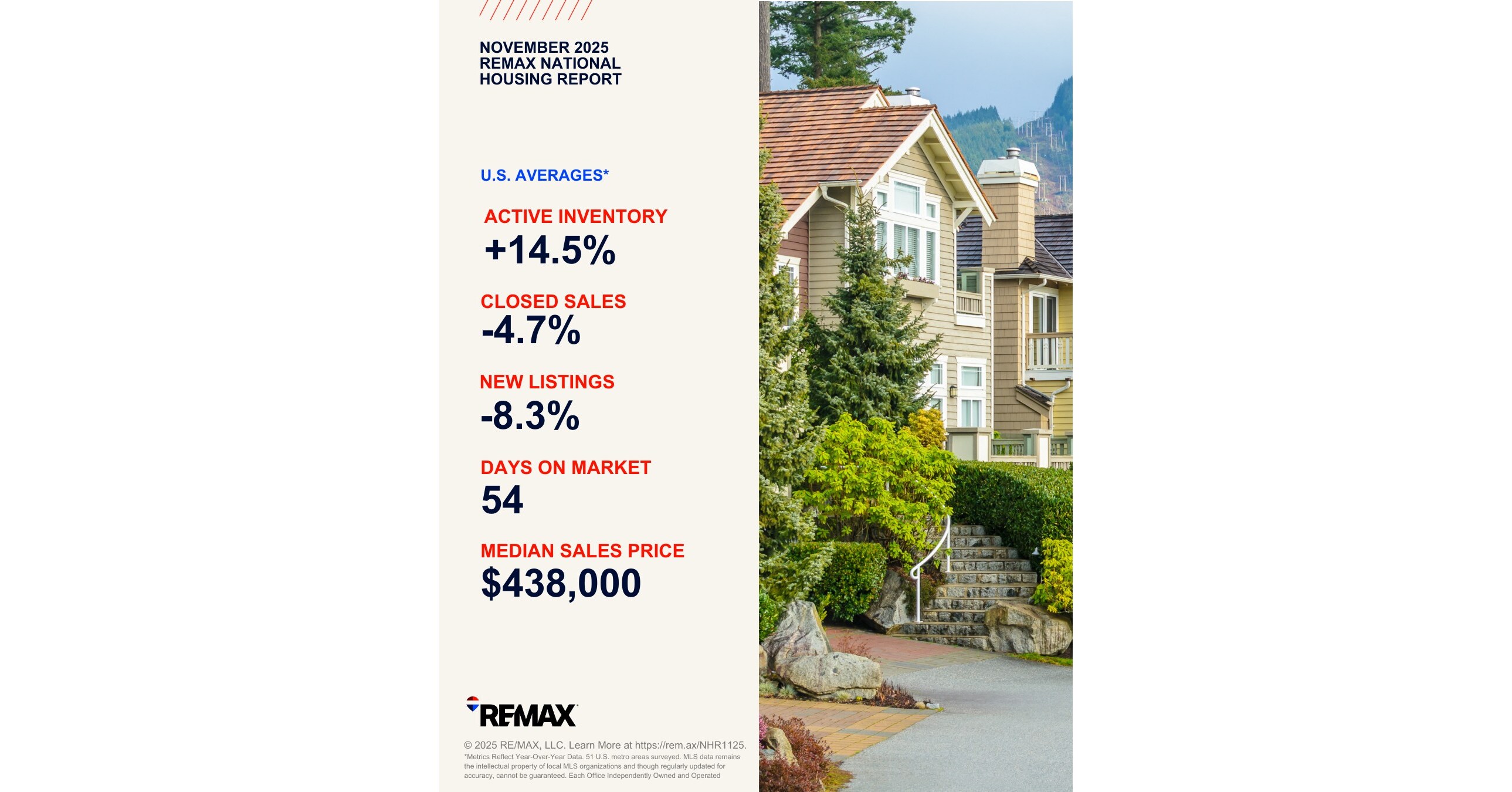
DENVER, Dec. 17, 2025 /PRNewswire/ -- November brought the expected seasonal cooling to the U.S. housing market, with fewer new listings and home sales compared to October as inventory levels remained elevated. Although the supply of homes declined 5.5% from October, it was still 14.5% higher than a year ago, marking the 23rd consecutive month of year-over-year inventory increases, a streak that dates to January 2024.
Across the 51 metro areas surveyed, new listings dropped 30.7% month over month, marking the largest decline among key metrics. Year-over-year, new listings fell 8.3%.
Buyers closed on 18.5% fewer home sales from October to November and 4.7% less than in November 2024, reflecting typical seasonal patterns.
November's Median Sales Price of $438,000 posted a 1.7% year-over-year gain, continuing a 29-month growth streak that began in July 2023. Prices eased 1.5% from October.
"While some numbers reflect the typical seasonal slowdown, others point to encouraging trends," said REMAX CEO Erik Carlson. "Inventory has continued to grow as prices have remained steady, pointing to a resilient market for both buyers and sellers. As the market continues to adjust heading into the new year, there's plenty of opportunity to make a smart move, especially with guidance from a trusted REMAX agent."
Other metrics of note:
One notable shift came in Seattle, a market that typically ranks among the highest in median sales price but saw its largest monthly price drop of the year, declining 5.4% from $740,000 in October to $700,000 in November. John Manning, local Broker/Owner of REMAX Gateway, says several factors may be contributing to the cooling trend.
"Seattle has enjoyed decades of incredible growth driven by Washington State's appeal to a diverse mix of industries. More recently, shifts in tax policy appear to be influencing corporate decisions about where to allocate resources, which may be contributing to cooling home prices. We're also seeing signs of wealth relocation, as higher estate taxes prompt some higher-net-worth residents, particularly seniors, to consider relocating later in life. At the same time, changes in the tech sector driven by artificial intelligence are reshaping hiring patterns that once fueled an influx of younger tech workers into the Seattle area."
Highlights and local market results for November include:
New Listings In the 51 metro areas surveyed in November 2025, the number of newly listed homes was down 8.3% compared to November 2024, and down 30.7% compared to October 2025. The markets with the biggest decrease in year-over-year new listings percentage were Dover, DE at -48.6%, Trenton, NJ at -48.3%, and Washington, DC at -45.2%. The markets with the biggest year-over-year increase in new listings percentage were Bozeman, MT at +21.8%, Burlington, VT at +10.4%, and St. Louis, MO at +9.8%.
Closed TransactionsOf the 51 metro areas surveyed in November 2025, the overall number of home sales was down 4.7% compared to November 2024, and down 18.5% compared to October 2025. The markets with the biggest decrease in year-over-year sales percentage were San Antonio, TX at -22.9%, Bozeman, MT at -15.7%, and Anchorage, AK at -13.5%. The markets with the biggest increase in year-over-year sales percentages were Wichita, KS at +12.0%, Miami, FL at +10.4%, and Honolulu, HI at +5.3%.
Median Sales Price – Median of 51 metro area pricesIn November 2025, the median of all 51 metro area sales prices was $438,000, up 1.7% from November 2024 and down 1.5% compared to October 2025. The markets with the biggest year-over-year increase in median sales price were Trenton, NJ at +13.6%, Cleveland, OH at +11.8%, and Cincinnati, OH at +10.2%. The markets with the biggest year-over-year decrease in median sales price were Seattle, WA at -4.7%, Tampa, FL at -3.5%, and Richmond, VA at -2.5%.
Close-to-List Price Ratio – Average of 51 metro area pricesIn November 2025, the average close-to-list price ratio of all 51 metro areas in the report was 98%, down from 99% in November 2024 and the same as October 2025. The close-to-list price ratio is calculated by the average value of the sales price divided by the list price for each transaction. When the number is above 100%, the home closed for more than the list price. If it's less than 100%, the home sold for less than the list price. The metro areas with the biggest year-over-year decrease in close-to-list price ratios were Burlington, VT at -2.1 pp (98.3%), Dover, DE at -1.5 pp (98.6%), and Baltimore, MD at -1.2 pp (99.5%). The metro areas with the biggest year-over-year increase in close-to-list price ratio were Philadelphia, PA at +0.3 pp (99.9%), followed by Des Moines, IA (98.6%), Kansas City, MO (99.2%) and Coeur d'Alene, ID (98.2%) tied at +0.2 pp.
Days on Market – Average of 51 metro areasThe average days on market for homes sold in November 2025 was 54, up seven days compared to the average in November 2024 (47) and up four days compared to October 2025 (50). The metro areas with the biggest year-over-year increase for days on market averages were St. Louis, MO at +39.1% (44 days), Manchester, NH at +38.7% (27 days) and Washington, DC at +28.7% (39 days). The markets with the biggest year-over-year decrease for days on market averages were Fayetteville, AR at -14.2% (65 days), New Orleans, LA at -5.1% (64 days) and Hartford, CT at -2.7% (24 days). Days on market is the number of days between when a home is first listed in an MLS and a sales contract is signed.
Months' Supply of Inventory – Average of 51 metro areasThe number of homes for sale in November 2025 was up 14.5% from November 2024 and down 5.5% from October 2025. Based on the rate of home sales in November 2025, the months' supply of inventory was 3.3, up from 2.9 from November 2024 and up from 3.0 from October 2025. In November 2025, the markets with the highest months' supply of inventory were Miami, FL at 7.5, San Antonio, TX at 6.5 and Bozeman, MT at 6.1. The markets with the lowest months' supply of inventory were Hartford, CT at 1.3, Manchester, NH at 1.4 and Seattle, WA at 1.5.
About the REMAX NetworkAs one of the leading global real estate franchisors, RE/MAX, LLC is a subsidiary of RE/MAX Holdings (NYSE: RMAX) with more than 145,000 agents in nearly 9,000 offices and a presence in more than 110 countries and territories. Nobody in the world sells more real estate than REMAX, as measured by residential transaction sides. REMAX was founded in 1973 by Dave and Gail Liniger, with an innovative, entrepreneurial culture affording its agents and franchisees the flexibility to operate their businesses with great independence. REMAX agents have lived, worked and served in their local communities for decades, raising millions of dollars every year for Children's Miracle Network Hospitals® and other charities. To learn more about REMAX, to search home listings or find an agent in your community, please visit www.remax.com. For the latest news about REMAX, please visit news.remax.com.
Report DetailsThe REMAX National Housing Report is distributed monthly on or about the 15th. The Report is based on MLS data for the stated month in 51 metropolitan areas, includes single-family residential property types, and is not annualized. For maximum representation, most of the largest metro areas in the country are represented, and an attempt is made to include at least one metro area in almost every state. Metro areas are defined by the Core Based Statistical Areas (CBSAs) established by the U.S. Office of Management and Budget.
DefinitionsClosed Transactions are the total number of closed residential transactions during the given month. Months' Supply of Inventory is the total number of residential properties listed for sale at the end of the month (current inventory) divided by the number of sales contracts signed (pending listings) during the month. Where "pending" data is unavailable, an inferred pending status is calculated using closed transactions. Days on Market is the average number of days that pass from the time a property is listed until the property goes under contract. Median Sales Price for a metro area is the median sales price for closed transactions in that metro area. The nationwide Median Sales Price is calculated at the nationwide aggregate level using all sale prices from the included metro areas. The Close-to-List Price Ratio is the average value of the sales price divided by the list price for each closed transaction.
MLS data is provided by Seventy3, LLC, a RE/MAX Holdings company. While MLS data is believed to be reliable, it cannot be guaranteed. MLS data is constantly being updated, making any analysis a snapshot at a particular time. Every month, the previous period's data is updated to ensure accuracy over time. Raw data remains the intellectual property of each local MLS organization.
SOURCE RE/MAX, LLC
...


Read the fullstory
It's better on the More. News app
✅ It’s fast
✅ It’s easy to use
✅ It’s free