EufyMake: Inside Anker’s push to turn UV printing into a consumer product

1 day ago
It was the night a USD 50 million success story was born.
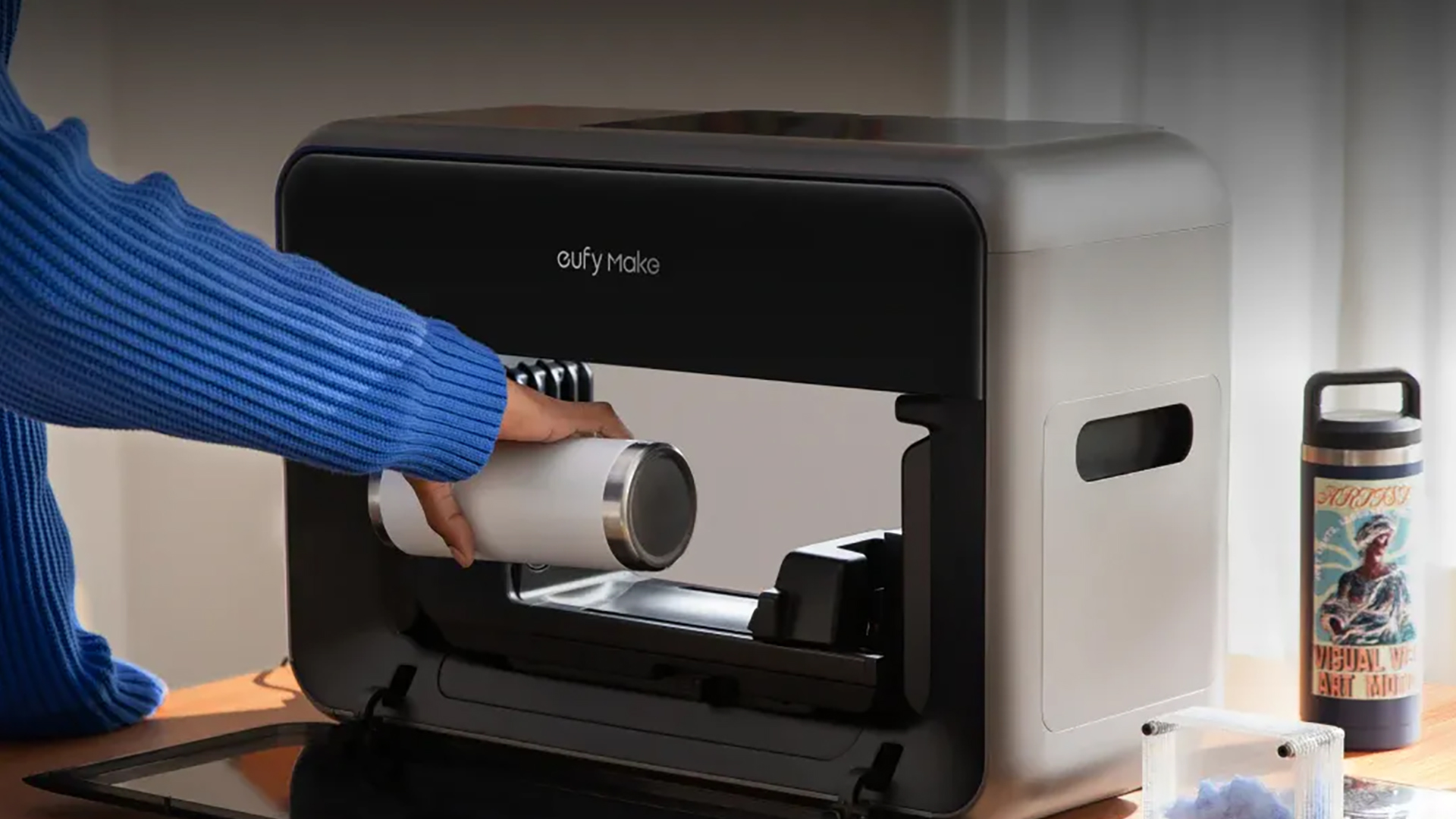
Cheney Xie, product and R&D lead for EufyMake, still remembers the rush of excitement. It was 10 p.m. on April 29, 2025, when the brand’s E1 UV printer went live for crowdfunding.
It took just one minute to reach the first USD 1 million.
No one slept that night. Until 4 or 5 a.m, team members were still posting screenshots of the real-time crowdfunding total.
To this day, the EufyMake E1 still holds the record for the highest-funded project in Kickstarter history, with USD 46.7 million raised.
Nearly a year has passed since the EufyMake E1 launched, and overseas delivery is now close to complete. The product has also officially gone on sale in China.
For both Anker Innovations and EufyMake, successful mass production and delivery carry milestone significance. Said to be the world’s first consumer-grade UV printer, producing the E1 required entirely new experience and complex supply chain integration.
The market had little confidence that the product could be delivered smoothly. Before developing the EufyMake E1, Anker had developed a 3D printer. Its first-generation printer also set a crowdfunding record, but mass production and delivery later ran into problems, and the project stumbled at launch.
To avoid repeating the earlier mass production problems of its 3D printer, the EufyMake team held nearly 200 review meetings this time. By day, they worked on the product. By night, they reviewed modules, trying to ensure that every part ultimately used the best architecture.
At the team’s most heated moments, Xie remembers the conference room door handle being broken.
Even so, during mass production at the 10,000-unit scale, mold tolerances still caused ink leakage. Under delivery pressure, engineers slept in the factory for a month to investigate the problem before ultimately deciding to remake the mold, restart production, and replace all affected components.
The team also entered the upstream supply chain for the first time. Take UV ink as an example. Although more than 80% of the world’s UV ink is produced in China, it is largely limited to industrial applications, and there was no established playbook for making consumer-grade UV ink. EufyMake had to work directly with the supply chain to meet standards for dust-free filling, environmental certification, chip-based control, and more. Costs kept rising, and 100 milliliters of UV ink sells for USD 42.99. Expensive ink became one of the issues users frequently discussed after using the product.
This was a difficulty the team had not anticipated when it first designed the UV printer. Xie said that at every stage of the project, he kept asking himself whether he had made the right choice and whether there was still room for improvement. Even after successful delivery, Xie still believes this generation is not perfect, and that there are many opportunities for innovation.
The EufyMake E1 has also created new momentum in the industry. 36Kr learned that other companies have since started developing UV-related hardware products of their own.
36Kr spoke with Xie about what the team experienced behind its breakout product, and how Anker put its ideas into practice.
The following transcript has been edited and consolidated for brevity and clarity.
36Kr: When EufyMake began visiting factories in 2023, had it already decided to enter the UV printer category?Cheney Xie (CX): At the time, after in-depth interviews with more than 50 makers and survey research with over 2,000 makers, we found that what users truly needed was a creative tool.
Every work has three dimensions: shape, color, and texture. FDM (fused deposition modeling) solves only shape, not color or texture. Laser engraving solves cutting and part of surface texture, but not color. UV printing technology has existed in the industrial sector for decades. It can solve the color problem and also create based on existing objects, giving it very broad commercial application scenarios.
The market was blank at the time. We spent more than half a year on technical research. By the end of 2023, we decided to make a strategic adjustment, abandon the FDM market, and go all in on UV printers.
36Kr: When Anker was validating the EufyMake E1 at the end of 2023, it was an entirely new category, and the team did not have similar experience before. What was the hardest part of getting the go-ahead?CX: The resistance during the 2023 report was not as great as imagined. We have a very clear standard for deciding whether to launch a product: can this product become truly globally leading in one dimension? Either it creates something no one has ever made before, or it surpasses everyone else on an experience metric that users care about most. If we cannot explain that clearly, it usually means the matter has not been thought through, or that the direction is not worth betting on.
At the time, we reported two opportunities. Later, the boss asked us to choose one and gave us another three months for validation. After the final round of validation, we chose UV, because the insights showed that users liked the concept very strongly.
36Kr: UV printing was originally an industrial-grade product. During technical research for EufyMake, did some parts seem extremely challenging, or even possibly impossible?CX: Yes. For example, the cost of the inkjet system. Industrial equipment costs RMB 100,000 (USD 14,719.1) to RMB 200,000 (USD 29,438.2) per unit, and we needed to bring that down to one-tenth. At the time, we asked solution providers. A printhead control board sold for RMB 40,000 (USD 5,887.6). I asked whether it could be cheaper at high volume. The answer was that the cheapest would be RMB 4,000 (USD 588.8). We could not afford RMB 4,000 either.
Later, after disassembly, we found that the bill of materials cost of the board itself was only about RMB 400 (USD 58.9). The high price came from R&D. Industrial solution providers sell only a few thousand boards a year while supporting more than 100 R&D staff, so the costs were all allocated into the price.
Since we judged that the material cost was actually only about RMB 400, we decided to develop it ourselves. As long as we could break through with self-developed technology, the cost would come down. Nobody had done it before, so we were nervous, but the logic worked.
36Kr: What exactly does this control board do?CX: It controls the entire printhead’s inkjet drive, inkjet algorithm, and so on.
36Kr: When EufyMake was making this product, the team found that industrial equipment is divided very finely, including flatbed printers, rotary printers, crystal label printers, and roll-to-roll printers. How did you integrate them?CX: Industrial specialization is designed for large-scale business, but our users are long-tail creators. We had to compress the functions of those four machines into one, while shrinking the volume to one-tenth of an industrial machine.
The early architecture was overturned three times. At first, we used a single swing arm, but the precision could not meet the 30-micron requirement. Later, we borrowed from the gantry structure of 3D printing and created a staggered dual-Y-axis design, flattening the machine’s profile.
With this architecture, different platform plates can be swapped easily. For a rotating object, you just change to a rotary accessory and lock it in place. To ensure stability, we used a 1,250-ton integrated die-casting process for the first time to cast the X-axis frame and ensure stability during movement.
36Kr: Just for this architecture, roughly how many times did EufyMake overturn and restart?CX: Three times.
36Kr: The first three times should not have reached the mold opening stage. After opening the mold, did EufyMake ever start over again?CX: Once, when we were working on 3D texture.
It was the second half of 2024. The project had already opened the mold. We saw textured paintings at an exhibition, and they were extremely inspiring. Textured paintings are built up layer by layer and can simulate various textures, creating stunning effects.
Later, we also went to Dafen Village, printed some samples of textured paintings, and spoke with users. Their eyes lit up when they saw them. So we decided that even if the project had to be delayed and the mold remade, we would make 3D texture the product’s biggest innovation.
36Kr: That sounds difficult. What was most difficult about 3D texture for EufyMake?CX: The difficulty was in the full chain.
First, there had to be a model. Ordinary consumers do not know how to turn an image into a 3D model. So at the software level, we needed to train using a large language model. Oil paintings, reliefs, faces, and landscapes all require different algorithms and need to be trained separately.
Then there is the stacking algorithm. If the precision is insufficient or a hole is clogged, the stacked area becomes a pit. We studied this for more than a year before figuring it out. Although no one on the team had done inkjet printing before, we had an algorithm team and experience in hardware architecture, sensors, and artificial intelligence inspection from 3D printing, so we could handle it.
36Kr: Did mass production create an entirely new challenge for EufyMake?CX: Mass production was indeed very challenging. Nobody had ever produced UV printers at the scale of tens of thousands or hundreds of thousands of units. For industrial-grade machines, selling 1,000 units a year is already the ceiling. Crowdfunding far exceeded expectations. We originally aimed for USD 10 million, but ended up raising more than USD 40 million. The pressure was enormous.
36Kr: What difficulties were there in delivery? AnkerMake’s 3D printer previously had delivery problems, and 3D printing is relatively mature, while the UV printer EufyMake is making now has no precedent.CX: The core issue was still redefining things. We placed 100 machines in the factory and ran stress tests every day. We printed several metric tons of ink. That was money spent to pile up testing. To guarantee delivery quality, our engineers chose to station themselves in the factory and solve the engineering issues of integrated die casting together with the die-casting factory.
36Kr: Did EufyMake learn from AnkerMake’s previous 3D printer?CX: Of course. This time, we did a lot of work in early simulation and architecture validation. The team ran experiments during the day and held review meetings at night. There were more than 200 such review meetings. We checked the optimal architecture module by module.
36Kr: In the whole process, where did the most intense conflict happen?CX: There were actually many. The team argued fiercely.
For example, the product manager insisted that the weight could not exceed 20 kilograms, because users might not be able to carry it. So every component’s weight had to be scrutinized. Someone would ask whether an extra 0.5 millimeters really mattered, and if users would refuse to buy the product because of that extra thickness.
But that is the spirit of making products. If you loosen up here, you will loosen up in many other places later, including places you cannot see. You have to calculate and scrutinize every part. This process of adjustment lasted a year and a half and consumed a lot of energy.
36Kr: Regarding the supply chain, especially the printheads you mentioned, many are supplied by Japanese manufacturers and are extremely expensive. Were you worried about supply stability or bargaining power? How did you handle this?CX: Yes. Aside from printheads, we control the other technologies ourselves. China has not made a breakthrough in printheads for decades, so we can only work with factories and suppliers to solve a large number of engineering problems. There is really no alternative in this area. We also hope to promote the possibility of localization of printhead production.
36Kr: Competitors such as xTool and Bambu Lab are now following up. Since printheads are still not domestic, when competition intensifies, could there be risk on the supply side?CX: That is hard to say. It is like mobile phone chips. Deep cooperation can secure priority supply. I think competition is inevitable, but in the end, it is still a process of mutual gain.
36Kr: One problem we had not realized is that some consumers see EufyMake’s ink as expensive. Why is that?CX: UV printing has existed for decades, but it was mainly used in industrial fields. At present, more than 80% of the world’s UV ink is basically produced in China.
In the early stage, we thought very simply: since ink is all produced in China, could we not just procure from a supplier? Later, we found that industrial standards and consumer-grade standards are completely different. Industrial machines cost hundreds of thousands of RMB and are used in factories, while what we are making is used at home. The scenario is completely different.
Consumer-grade ink first needs to be safe and environmentally friendly. We approached UL, a top certification body, to understand what the top standards for safety and environmental protection were. We needed to follow the strictest standard, called Greenguard Gold.
We need to ensure that after printing, children can touch the output directly. Although category limitations mean we cannot yet reach food-grade safety, we must at least ensure that children touching it is not a problem. This was the first standard we set.
Second is quality. We need to produce the kind of effect that makes people say “wow,” so print quality has to meet industrial-grade standards. At the time, we set a standard that the color difference (Delta E) must be less than six. Once it exceeds that value, visible color gradation differences can be seen by the naked eye, and it is not acceptable.
Another issue is printhead clogging. If an industrial machine’s printhead clogs, professional workers can use a syringe to clean it. In reality, our consumers cannot use a syringe to clean it themselves. So we set high specifications for ink quality control and impurity filtration. From large-scale filtration to filling, ink must be handled in a Class 10,000 cleanroom environment. Industrial ink pursues scale and low cost, so it does not do this. But once we redefined consumer-grade standards, costs naturally rose.
Finally, for safety, we made the ink cartridge sealed. Before curing, ink is somewhat corrosive, and long-term skin contact may cause allergies, so we had to reduce users’ chances of touching the ink. We also added chips and QR codes to the cartridges so they can be tracked from the production source, and users are even reminded when they are close to expiry.
Many users did not understand these things early on. They felt that industrial ink was so cheap, so why should ours be so much more expensive? We heard these voices and are now looking for new solutions while ensuring safety and high quality.
36Kr: I heard that UV printers generally have printhead clogging problems. Is EufyMake’s solution to use this box-like system and lock down the ink system?CX: The sealed system is one measure, but printhead clogging is a problem the entire inkjet printing industry has not fully solved in decades. In 2023, when we visited factories and studios, professionals told us that what they feared most was nobody maintaining the machine during Chinese New Year, because when they returned, a printhead worth tens of thousands of RMB could be ruined.
If we want ordinary users to keep using it, we must solve this problem. So we designed the Jet Clean automatic maintenance system. When the machine is not in use, it automatically fills in maintenance fluid, cleaning and moistening the printhead and ink path. This state is like when the machine has just left the factory. Even if users return from a one-month vacation, the machine is still fine.
Even if it clogs, users can tap Clean in the app and it will clean automatically. They do not need to inject water with a syringe. Industrial machines do not have this because professionals maintain them manually. We also made the printhead such that users can remove two screws to replace it, adding convenience.
Considering that printheads are expensive, we also created EufyMake Care, a printhead protection plan. It is like insuring against phone screen breakage: if it breaks within one year, we send a replacement for free.
36Kr: How much does a cartridge of EufyMake ink sell for now?CX: A cartridge is about 100 milliliters and sells overseas for USD 42.99. In China, it is a bit cheaper. A set of ink currently costs about RMB 999 (USD 147).
36Kr: How long can one set of EufyMake ink print, or how many products can it print? Have you calculated that?CX: It depends on what the user prints. If it is only flat objects, ink consumption is very low. For example, printing a small refrigerator magnet, one set of ink can print more than 2,000 pieces. But if you print 3D relief, because the ink is stacked layer by layer, one millimeter of thickness may require 20 layers. That consumes a lot of ink, and the cost becomes visible. For people doing SMBs, they can earn it back quickly. But for pure DIY hobbyists, paying that cost purely out of passion still feels expensive.
36Kr: Did EufyMake not expect at the beginning that ink would become a challenge?CX: At first, we thought finding a supplier would be enough. But once the standards were set, we found that basically no supplier could do it. What could we do? We could only work with factories on joint R&D and improve the formula together. It was really a process of solving each problem as it came.
Fortunately, we are backed by Anker’s supply chain. Many suppliers had long-term cooperation with Anker in the past. Apart from ink and the ink supply system, which are relatively unique, coordination with suppliers such as plastic mold factories is much smoother.
36Kr: What was the EufyMake team’s atmosphere and reaction after realizing the crowdfunding results?CX: It was really exciting. Nobody wanted to sleep that night. Watching the number rise felt like watching coins flood in. The first USD 1 million came in less than a minute. People were still posting screenshots in the group at 4 or 5 a.m.
36Kr: After crowdfunding, did EufyMake encounter challenges with production or delivery? What needed improvement?CX: The main issue was consistency in large-scale production. In fact, in the early stage, we did a lot of testing. We repeatedly tested hundreds of prototypes and also brought in external users for testing.
But later, we found that producing hundreds of hardware products and producing tens of thousands involve a gulf: consistency. For example, during batch production, mold tolerances in the metering tank produced deviations, resulting in a very small chance of ink leakage after extended use. This leakage did not appear immediately. It only surfaced after the machine had been used for some time.
After discovering it, we could not let users randomly receive problem units. We had to hold all shipments, investigate, and disassemble units. After locating the issue, we remade the mold.
The investigation took more than a month. Each item had to be checked one by one. The process was extremely difficult, and large-scale stress testing was needed to find the problem. After it was found, the mold had to be modified. Components also had to be remade. But these are problems that mass production at scale must face.
36Kr: What aspects of the EufyMake E1 still feel imperfect to you?CX: For example, print speed and ink cost are still imperfect. When we look at a technology or category, it follows a lifecycle curve. This category is still in the innovator stage, with many opportunities for innovation. There is definitely pressure, but the innovation opportunities here still create the possibility of making a very different next-generation product.
36Kr: You mentioned that you keep questioning yourself. At which stage was this self-examination most frequent?CX: It never stopped. Early on, we invited nearly 100 key opinion consumers to join the project group in advance. Every day, we spent time talking with them, visiting their homes, and observing how they used the product. We kept checking whether the design definition was correct.
After all, this is an entirely new product. When making it, you still need a sense of caution.
KrASIA features translated and adapted content that was originally published by 36Kr. This article was written by Leslie Zhang for 36Kr.
Note: RMB figures are converted to USD at rates of RMB 6.79 = USD 1 based on estimates as of May 28, 2026, unless otherwise stated. USD conversions are presented for ease of reference and may not fully match prevailing exchange rates.
...


Read the fullstory
It's better on the More. News app
✅ It’s fast
✅ It’s easy to use
✅ It’s free