Marshall’s RM5,899 Bromley 750 Takes a Different Approach to the Party Speaker Formula

1 hour ago
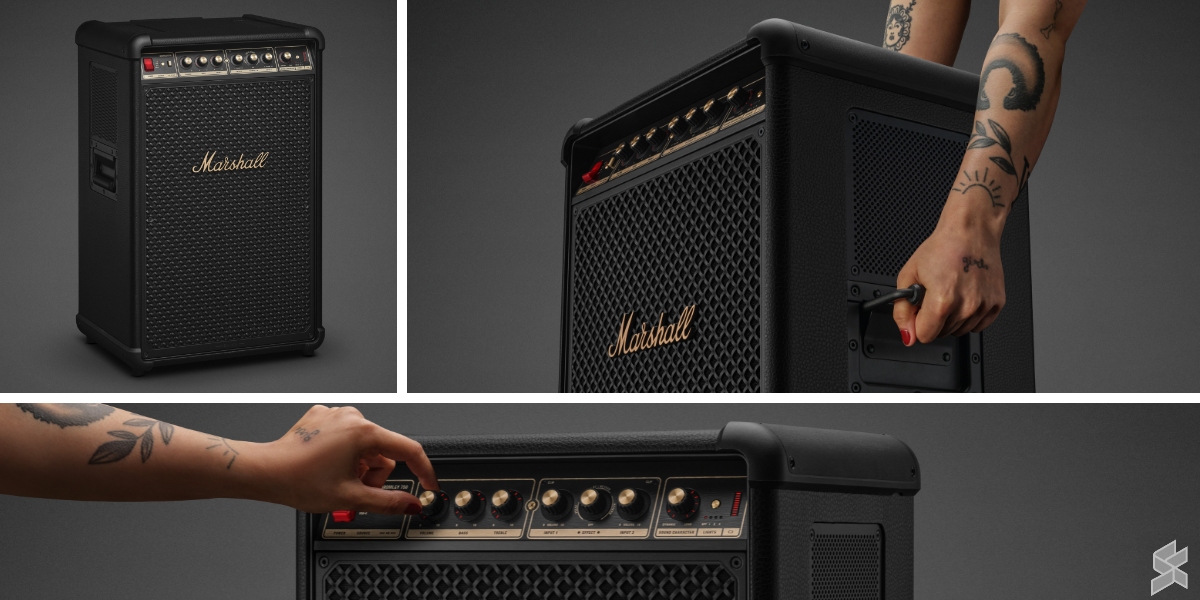
Party speakers have become a category defined by scale. Bigger cabinets, brighter light shows, and increasingly larger numbers on spec sheets now dominate the conversation. With the Bromley 750, Marshall is entering this space for the first time, but not by leaning on the same talking points as its rivals.
Rather than foregrounding headline wattage figures or app-heavy sound modes, Marshall is positioning the Bromley 750 around how sound behaves as volume rises, placing control, tonal character, and consistency at the centre of the experience.
That immediately puts it in conversation with similarly sized and priced speakers like Sony’s ULT Tower 10 and JBL’s PartyBox Ultimate, which target the same large-room and event use cases, but approach the problem very differently.
The Strategic Play: Why Enter the Party Now?Marshall is arguably late to the party, with JBL and Sony having dominated this space for decades. So why jump in now? The answer likely lies in a massive shift in consumer behaviour.
Industry data shows the Party Speaker segment is currently one of the fastest-growing categories in audio, projected to grow at over 20% annually through 2033. Post-pandemic, the demand for “Social Audio” or speakers powerful enough to anchor an outdoor gathering has skyrocketed.
However, the current market is almost entirely bifurcated between “toys” (plastic boomboxes with flashing strobes) and “tools” (ugly, industrial PA systems). Marshall has identified a lucrative gap in the middle: the “grown-up” party host.
There is a generation of music lovers who want stadium-level volume but refuse to put a neon-lit plastic tower in their well-curated living room. By offering a speaker that looks like a heritage amplifier, Marshall is betting that consumers will pay a premium for “loud” that still looks luxurious.
Built to move between spacesUnlike many large-format party speakers that are designed to stay in one location, the Bromley 750 is built with mobility in mind. It features integrated wheels and side handles, allowing it to be moved between rooms, venues, or outdoor spaces by a single person.
The Bromley 750 weighs 23.9kg and features a brushed-metal control panel, a water-based PU leather exterior, and a stamped-metal grille. It is designed and engineered in Sweden, with manufacturing in China.
An IP54 dust- and splash-resistant rating further supports use in less-controlled environments, such as outdoor gatherings.
By comparison, both the Sony ULT Tower 10 and JBL PartyBox Ultimate also include wheels and handles, but are AC-powered only speakers intended primarily for stationary or semi-permanent setups. While they can be repositioned, both require a constant mains power connection, whereas the Bromley 750 can operate entirely off-grid using its internal battery.
The Sony ULT Tower 10 weighs approximately 29kg and uses a tall, tower-style form factor optimised for indoor use. The JBL PartyBox Ultimate is the largest and heaviest of the three at 39.5kg, reinforcing its positioning as a semi-permanent party setup rather than a frequently moved system.
Sony’s speaker is splash-resistant on its top surface but does not carry an IP rating, while JBL’s PartyBox Ultimate is rated IPX4.
Power and battery flexibilityPower management is a key differentiator for the Bromley 750. It uses a replaceable lithium iron phosphate (LiFePO4) battery, which comes pre-installed and can be removed for separate charging. The battery also functions as a power bank, offering USB-C output at 5V/3A.
The speaker can operate directly from mains power with or without the battery installed, charging the battery simultaneously when connected.
Marshall estimates over 40 hours of playtime under typical usage conditions at moderate volume with lighting disabled. A 20-minute quick charge provides up to five hours of playback, while a full recharge takes approximately 3.5 hours, depending on usage conditions.
Both the Sony ULT Tower 10 and JBL PartyBox Ultimate rely entirely on AC power to operate. While both offer USB charging for external devices, neither can operate without being plugged into a mains power supply.
Sound tuning: physical control versus presets and processingMarshall takes a hardware-led approach to sound tuning on the Bromley 750. Instead of a traditional gain control, the speaker features a Sound Character knob that works alongside the volume dial to adjust tonal balance, compression, and harmonic content simultaneously. The control ranges from 1 to 13, with a progressive response at each step.
Marshall divides this range into three functional zones. At steps 1 to 3, the speaker operates with a flat EQ profile intended for smaller rooms or more faithful playback. From steps 4 to 8, bass response and dynamic energy increase gradually, making it more suitable for medium-sized spaces or outdoor use. At steps 9 to 13, the system applies maximum character compression and a custom EQ curve optimised for sustained high-volume playback, which Marshall refers to as Party Mode.
Sony approaches tuning on the ULT Tower 10 through preset sound modes, offering ULT1 for deeper bass and ULT2 for higher impact. Further adjustments are handled via a 7-band EQ in Sony’s companion apps, alongside Sound Field Optimisation, which adapts output based on placement.
JBL’s PartyBox Ultimate leans heavily on digital processing. The speaker features automatic self-tuning, adjusting its sound profile each time it powers on, depending on whether it is used indoors or outdoors. When streaming over Wi-Fi, it also supports Dolby Atmos, enabling spatial audio playback with compatible high-definition music services.
Most tuning and EQ adjustments are handled through the JBL One app, supported by physical controls on the speaker itself.
Drivers, amplification, and scaleThe Bromley 750 uses a closed cabinet design with a total of eight drivers and a 3-way audio architecture, consisting of:
Powering the system is a multi-amplifier Class D architecture, with dedicated amplification for each driver group. Marshall assigns 100W amplifiers to each woofer, 50W amplifiers to each mid-range driver, and four 50W amplifiers to the tweeters.
Rather than promoting a single combined wattage figure, Marshall highlights a maximum sound pressure level (SPL) of 127dB at one metre, positioning the Bromley 750 as a speaker capable of filling large spaces from a single unit. The system operates in stereo and covers a frequency range of 20Hz to 20kHz.
Sony does not disclose output or SPL figures for the ULT Tower 10. Its driver layout includes a large woofer, dual mid-range drivers, and front- and rear-firing tweeters, designed to project sound both forwards and around the room. Sony instead lists a power consumption rating of approximately 139W, which reflects electrical draw rather than audio output.
JBL takes a more specification-forward approach with the PartyBox Ultimate. It features:
JBL rates the system at 1,100W RMS (IEC60268), with a frequency response of 30Hz to 20kHz (-6dB), positioning it as the most output-focused speaker of the three.
Both Sony and JBL support stereo pairing and multi-speaker linking, allowing users to connect multiple compatible speakers to expand the soundstage and coverage. Marshall, in contrast, positions the Bromley 750 as a single-unit solution designed to deliver consistent, high-output performance on its own.
Lighting and interactionLighting is integrated across all three speakers, though with different priorities. The Bromley 750 includes three built-in stage lighting presets, controlled directly from the speaker via a dedicated Light button. Users can also turn the lighting off entirely, which Marshall notes can help extend battery life during longer sessions. Custom lighting configurations are limited to preset selection.
JBL places a stronger emphasis on visual spectacle. The PartyBox Ultimate features a large, multi-zone light show synchronised to music, with extensive customisation available through the JBL One app. It also includes PartyPad controls on the top panel, allowing users to trigger sound effects using tap, hold, and slide gestures.
Sony’s lighting implementation is more restrained, with effects primarily controlled through its mobile apps rather than on-device controls.
Connectivity and inputsThe Bromley 750 supports Bluetooth 5.3, Bluetooth multipoint, and Auracast, with a stated wireless range of over 70 metres in free-field conditions. Supported codecs include SBC, AAC-MPEG 2, and LC3. Wired connectivity includes 3.5mm AUX (input and output), USB-C, RCA input, and two XLR/6.35mm combo jacks for microphones or instruments.
Independent volume and effects controls for each input, along with dedicated Bass and Treble knobs, are available directly on the top panel, alongside a programmable M-button and battery indicator.
Sony’s ULT Tower 10 supports Bluetooth 5.2 with SBC, AAC, and LDAC, as well as Stereo Pair and Party Connect. Wired connections include a 3.5mm input, USB-A for playback and charging, an optical digital input for TV connectivity, and a single mic or guitar input. Sony also includes a wireless microphone, optical cable, and batteries in the box.
The JBL PartyBox Ultimate supports Bluetooth 5.3 and Wi-Fi streaming across 2.4GHz and 5GHz networks, enabling higher-quality playback and Dolby Atmos support. Wired connections include dual microphone inputs, a guitar input, 3.5mm AUX, and USB playback, with support for MP3 and WAV files.
Price positioning and where Bromley 750 fitsIn Malaysia, the Sony ULT Tower 10 is priced at RM4,599, the Marshall Bromley 750 at RM5,899, and the JBL PartyBox Ultimate at RM6,999. Positioned between Sony and JBL in terms of price, the Bromley 750 combines battery-powered flexibility, physical sound controls, and high-output performance in a segment traditionally dominated by fixed-location speakers.
With the Bromley 750, Marshall expands its product portfolio into the party speaker category, offering a distinct balance of portability, control, and scale while staying aligned with the brand’s established design and audio identity. Whether that approach resonates will depend on what buyers expect from a party speaker.
...


Read the fullstory
It's better on the More. News app
✅ It’s fast
✅ It’s easy to use
✅ It’s free