Southeast Asian beauty brands seek overseas gloss to bolster growth
1 day ago
Singapore-based marketing consultant Sabrina Marican discovered premium Thai beauty and wellness brand Panpuri on a trip to Bangkok. “Their products are mostly oil-based, rather than alcohol-based, and I find them good for my skin,” she said. When the brand opened its first store in Singapore in late 2025, she was elated.
Shoppers like Marican are the target for homegrown Southeast Asian beauty brands like Panpuri, as they expand from their countries of origin. “For many years, Singaporean travelers were discovering us while visiting Bangkok, so opening a dedicated boutique in the country felt like a natural next step,” said Vorravit Siripark, Panpuri’s founder and CEO.
The company is far from unique. Brands from Indonesia to Thailand, which have built strong connections with consumers in their domestic markets, are now spreading their wings across Asia in an industry that appears to defy the broader economic headwinds battering much of the region.
Last year, beauty and personal care sales in Southeast Asia recorded double-digit growth in most countries, far outstripping gross domestic product expansion. For example, Thailand’s GDP grew at a measly 2.4% pace in 2025, while its beauty sector grew 9.4%, according to Euromonitor International, a market intelligence company. Malaysia saw the region’s highest growth rate in the beauty and personal care sector at 11.8%, more than double the country’s GDP growth rate of 5.2%.
“Beauty is one of the few consumer goods categories where the price per unit weight is growing fast,” said Tyrone Almeida, a partner at Bain & Company, a consulting firm. “This is driven more by the introduction of new premium products at price points that can go as high as thrice current product prices, as opposed to general price-ups of current products which, at most, are at 10–15%.” Consumers are willing to spend more on beauty, with the amount spent on the category per person across most countries being 30–60% higher in 2025 compared with 2019.
Within beauty, Euromonitor analyst Laura Tjahjadi believes the robust growth in skin care, usually the largest subcategory, and cosmetics is driven by key consumer behavior. “Ingredient-led skin care is gaining traction across the region,” she said. “Consumers are becoming more knowledgeable and searching for specific ingredients, like vitamin C or niacinamide, rather than broad claims such as ‘brightening.'”
People also want their cosmetics to be doing more. “We are seeing growing interest in multifunctional makeup products, such as skin tints and hybrid lip products that combine color cosmetics with skin care benefits,” said Ghea Yantra, senior vice president of marketing operations at Social Bella, which operates Sociolla, an Indonesia-based omnichannel beauty retailer that is also present in Vietnam.
There are also country-specific trends. Almeida pointed to the rise of labels such as halal and locally sourced in Muslim-majority Indonesia and Malaysia, and new delivery formats like ingestibles, such as collagen mini drinks, in Thailand.
Homegrown brands are meeting those needs by offering differentiated solutions. Siripark emphasized that he does not want to compete with European beauty houses, but instead showcases Thai wellness traditions. “Growing up in Thailand, I was surrounded by traditions of wellness, scent and ritual,” he said. “Yet when I looked at the global beauty landscape over 20 years ago, I felt that Thailand’s heritage of beauty and wellness was not being represented well. I wanted to create a brand that expressed Thai wellness philosophy through modern craftsmanship.”
The results are starting to be seen in the sales rankings. Euromonitor data shows L’Oreal’s Maybelline is the most popular cosmetics brand in Malaysia, the Philippines, Thailand, and Vietnam, and global products still dominate almost everywhere, but domestic brands are starting to muscle their way into the bestseller lists. In Indonesia, Paragon’s flagship brand Wardah has been the country’s bestselling beauty brand for more than six years, and local products now occupy six of the top seven places. In the Philippines, domestic brands fill half of the top ten slots. In Thailand, it is four out of the top seven.
The ascent of local brands has been helped by them usually being quicker at tailoring their product lines to the tastes and needs of each country’s consumers, Tjahjadi said, while global brands tend to sell the same products everywhere.
In Thailand, where consumers are open to experimenting with new products, local makeup brand Karmart has a stable of nearly 20 brands selling everything from dermatologist-developed facial masks to vegan beauty products. These have helped it grow its revenue 19% from 2023–2025 to THB 3.48 billion (USD 106.6 million).
In Vietnam, cosmetics brand Cocoon shows off local ingredients like Hau Giang lotus and Dak Lak coffee, playing to younger consumers’ sense of national pride.
Social media has played a strong role in beauty’s rapid rise, and local brands have leveraged it well. Euromonitor data shows that e-commerce comprises nearly a third of beauty sales in the Asia Pacific region. Live streaming and TikTok Shop have helped buyers find new products and encouraged them to experiment, with a Bain study showing that beauty is among the top performing categories on TikTok Shop in Southeast Asia.
“The beauty industry is moving away from mainstream advertising with celebrities to prioritizing crowdsourced validation such as online reviews and live demos,” said Almeida. “These trends have been better leveraged by local brands to negate the traditional advantages of scaled multinational brands on brand-building, communication and availability, which in the past required a certain minimum scale and spend to be viable.” Yantra pointed to the case study of Indonesia, where local brands strengthened their capabilities in formulation, packaging, and brand storytelling to grow 21% on Sociolla’s platform in 2025 year-on-year.
Having built solid customer bases in their home countries, some brands are venturing abroad. Thai brands have been in the vanguard of this global expansion, with China a popular market. Chinese visitors to Thailand rave about Thai beauty brands on social media platforms like Xiaohongshu and Douyin. Mass-market brands like Karmart and Mistine are investing more in China to capitalize on this interest, with the latter signing on a bevy of Chinese actors as brand ambassadors in the last 12 months.
Premium Thai beauty brands are not far behind. Panpuri’s foray abroad was preceded by brands like Harnn and Thann.
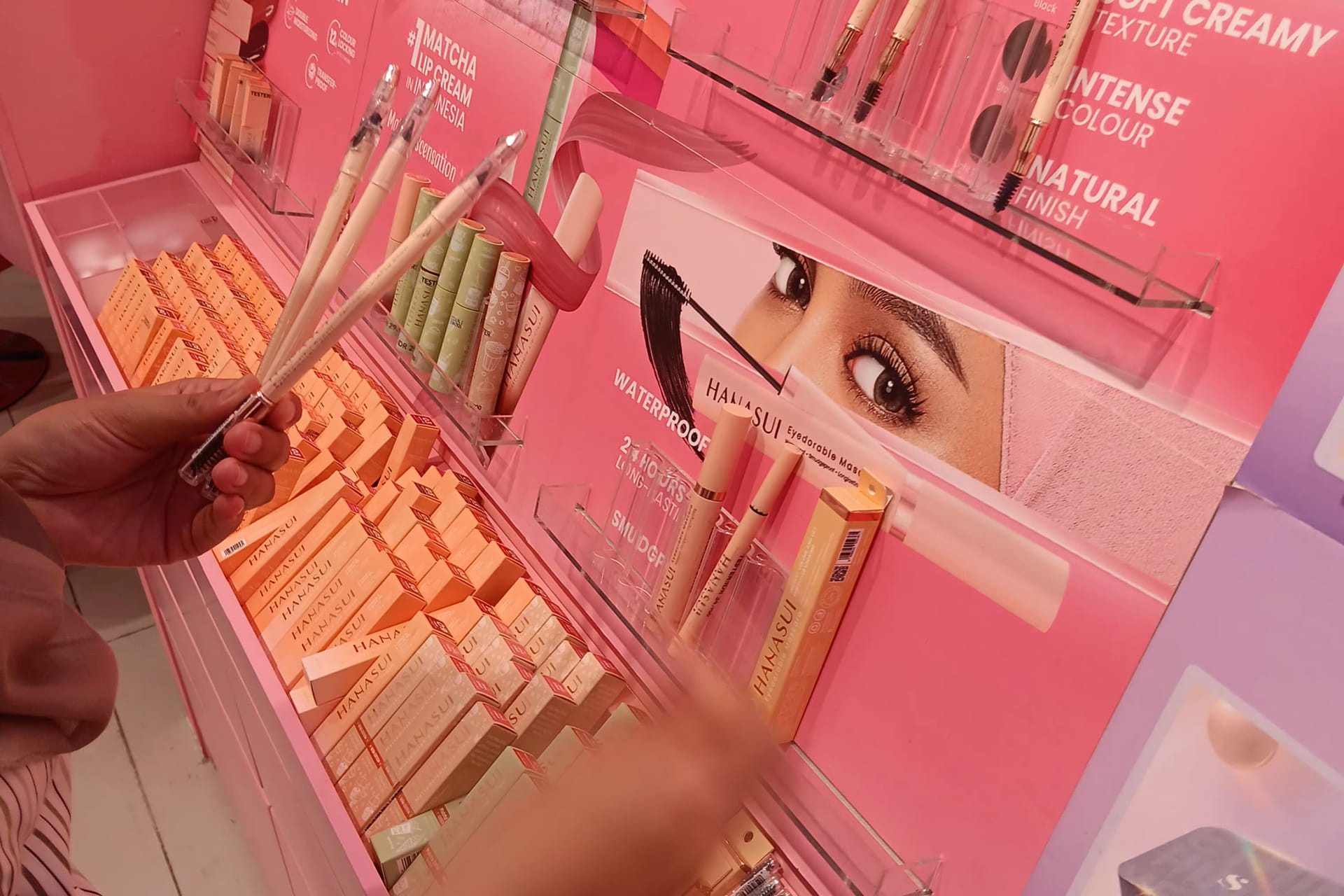
Indonesian brands like Wardah and Hanasui, the latter owned by Eka Jaya Internasional, have also been expanding internationally, with Malaysia the first target market. “Malaysia has a strong demand for halal-aligned formulations, so it makes sense that Indonesian brands like Wardah targeted Malaysia first as their halal positioning aligns with Malaysia’s large Muslim consumer base,” Tjahjadi said.
“It’s one of the few brands with halal certification, and that gives us peace of mind,” Rashidah Ibrahim, a 45-year-old bank executive in Kuala Lumpur, told Nikkei. “To be honest, I didn’t even realize it was from Indonesia.”
Wardah is also playing the affordability card. At Guardian, a major health and beauty retailer, its products are typically 10–15% cheaper than competing labels, including local brands such as Safi, Cosmoderm, and Aiken. “Customers say the products are comparable to international brands, but they gravitate toward Wardah mainly because of its affordability,” said Nicholas Leo, a shop assistant at a Watsons outlet in 1 Utama, the country’s largest mall, in Petaling Jaya.
The Middle East is also a prospective market for Indonesian brands; Wardah has partnered with the Qatar Foundation in a leadership initiative, a likely testing of the waters in the region before any big commercial move.
As they expand internationally, the newcomers face the same problems of localization and agility that multinationals encounter, along with the challenges of competing with entrenched local products. They need to adjust their operating playbooks and processes for the dual requirements of scale and speed to succeed in multiple markets, Almeida said.
They also have to contend with a recent disruption in the beauty space in Southeast Asia: the rise of so-called C-beauty. “Chinese beauty brands compete not only on price but also on superior digital marketing, trend responsiveness and operational speed,” Tjahjadi said. They have exploded in popularity across Southeast Asian markets. Euromonitor data shows Chinese brands like Focallure and Pinkflash in Indonesia, and Sace Lady and O.two.o in the Philippines, have risen into the top ten cosmetic brands in the respective countries in just a few years.
Almeida believes Chinese beauty brands to be the biggest competitive threat to local offerings, both in their home markets and abroad, as they combine the spending power of multinationals with the nimbleness and hyperlocal relevance of local brands. They are especially strong in e-commerce. A report on Indonesia’s skin care market by consultancy TMO Group analyzing the country’s Shopee sales shows that Skintific, a brand owned by Guangzhou Feimei Network Technology, is the platform’s bestselling moisturizer, ahead of Indonesian brands like Wardah and Suntone Wisdom Indonesia’s Glad2Glow.
Merely copying Chinese brands’ strategy will not help counter them, Tjahjadi said. “Homegrown brands will need to double down on what gives them an edge: their brand narrative, cultural relevance and ability to innovate thoughtfully in ways that stay true to their values.”
This article first appeared on Nikkei Asia. It has been republished here as part of 36Kr’s ongoing partnership with Nikkei.
Note: THB figures are converted to USD at rates of THB 32.66 = USD 1 based on estimates as of April 6, 2026, unless otherwise stated. USD conversions are presented for ease of reference and may not fully match prevailing exchange rates.
...


Read the fullstory
It's better on the More. News app
✅ It’s fast
✅ It’s easy to use
✅ It’s free