Why Tesla chose ByteDance’s Doubao for its AI push in China
8 hours ago
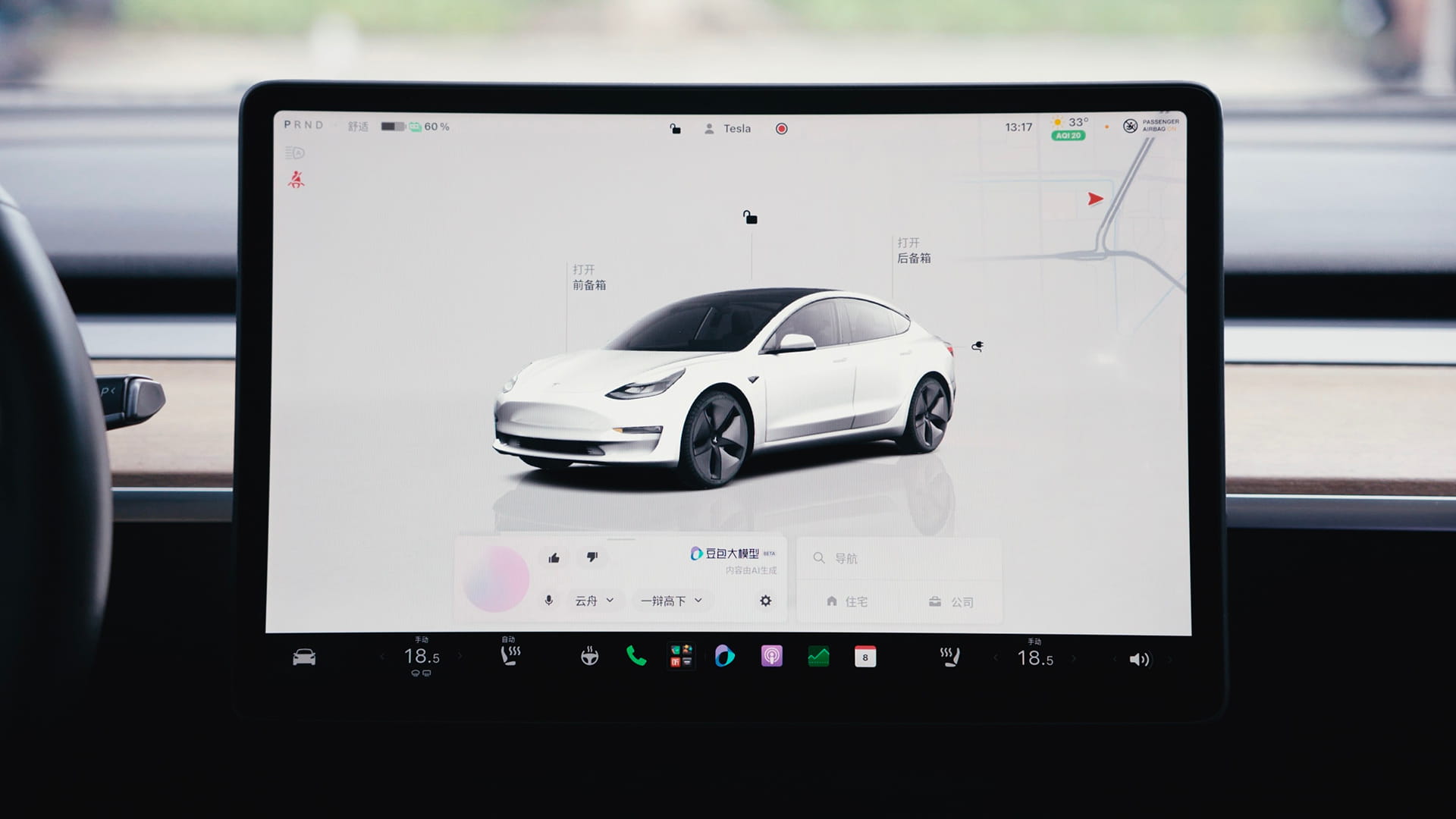
On July 31, Tesla China began rolling out an in-car software update in batches to Model 3, Model Y, Model S, and Model X vehicles. The update brings ByteDance’s Doubao large language model (LLM) into Tesla’s infotainment system.
For now, Doubao operates as a standalone app with four voice options. Users can chat with it, ask questions using real-time internet access, debate topics, listen to stories, sing along, and practice spoken languages.
It marks the first time in Tesla’s more than decade-long presence in China that the company has integrated a third-party LLM into its infotainment system. For a company that has long emphasized in-house AI development, the decision stands out in one of its largest markets.
Tesla’s technology choices have often influenced the broader automotive sector. Full Self-Driving (FSD) has long served as a reference point for assisted driving developers, while the integration of Grok into Tesla vehicles last year brought renewed attention to AI-based cockpit interaction.
LLMs potentially change the role of the vehicle assistant from a system that responds to simple commands into one that can understand context, sustain conversations, and eventually coordinate tasks across the vehicle.
But Tesla’s AI strategy has developed differently in China.
Despite prolonged speculation about a wider rollout, FSD has yet to become broadly available to owners in the country. One of Tesla’s signature technologies has therefore had limited impact on its competitive position in the Chinese market.
Working with a local technology provider on cockpit intelligence is, therefore, seemingly a pragmatic option.
Earlier market reports suggested Tesla could deploy both Doubao and DeepSeek, while Qwen was also discussed as a possible partner. The latest software rollout, however, includes only Doubao.
With Doubao now entering Tesla vehicles, a possible localization strategy is beginning to take shape. In China, Tesla is working with Volcano Engine, ByteDance’s cloud and artificial intelligence unit, while Doubao could take on some of the cockpit functions Grok performs in North America.
If FSD eventually becomes broadly available in China, Tesla could potentially combine localized cockpit intelligence with its driving system in a setup similar to the one it is developing overseas.
Doubao addresses a longstanding cockpit weaknessThe value of the Doubao integration becomes clearer when viewed against one of Tesla’s longstanding weaknesses in China: its relatively basic intelligent cockpit.
For years, Tesla’s voice assistant and cockpit interaction capabilities have lagged those of leading Chinese electric vehicle makers.
Nio’s Nomi supports more conversational interaction, while Li Auto’s Lixiang Tongxue can sustain multi-turn conversations and control functions across the vehicle. Tesla’s voice system, by comparison, has remained focused largely on basic commands such as adjusting the air conditioning or operating vehicle features.
In understanding Chinese-language context, sustaining conversations, and coordinating functions across different scenarios, Tesla has had ground to make up.
That mattered less when the company had clearer advantages elsewhere.
Tesla could rely on its electric powertrain technology, Supercharger network, brand, and expectations around FSD to distinguish its vehicles. Those strengths helped offset a less sophisticated cockpit experience.
But competition in China has changed. Domestic EV makers have narrowed the gap in areas including electric powertrains, chassis technology, and charging. Advanced driver assistance systems are also spreading into lower-priced vehicles, while LLMs are becoming increasingly common in vehicle cockpits.
Xiaomi has sought to integrate its MiMo model more deeply into its EVs, while Geely, Great Wall Motor, Seres, Li Auto, and other automakers have introduced LLM capabilities into their vehicles.
As those technologies become more widely available, Tesla has greater reason to improve an area that Chinese consumers interact with frequently.
Doubao offers one route to doing that.
Before the update, Tesla’s cockpit assistant was largely command-driven. Doubao adds conversational capabilities, including the ability to sustain dialogue and respond to a wider range of requests.
Its real-time voice system can also interpret aspects of tone, continue a conversation, and allow users to interrupt while it is responding.
That opens the door to uses such as travel guidance, music interaction, spoken-language practice, and storytelling.
The broader shift is from a voice-controlled interface toward an AI assistant capable of understanding more complex intent.
For Tesla, using an external model offers a faster way to close the gap than building an equivalent Chinese-language system from scratch.
More important is how deeply Doubao will eventually be integrated into the vehicle.
If FSD becomes broadly available in China, Tesla could potentially build a two-part AI system in which FSD handles driving while Doubao manages interaction and other cockpit functions.
In the short term, Doubao adds capabilities that Tesla’s China cockpit has lacked. Over time, it could become part of a broader localized AI strategy.
Why Tesla chose DoubaoTesla treats AI as central to its future. From Grok and FSD to computing infrastructure, Elon Musk has generally favored in-house development. Integrating a third-party LLM in China is therefore a notable exception.
Part of the explanation lies in localization.
FSD and an in-car AI assistant face different challenges. Driving systems depend heavily on local data, mapping, infrastructure, and regulatory requirements. An in-car conversational agent must additionally understand local language, culture, user habits, and everyday scenarios. Bringing Grok into China would therefore involve more than deploying an existing model.
Using a local partner offers another route.
Sources told 36Kr that Tesla evaluated LLM providers in China against a demanding set of criteria and that Musk participated in the review process at one stage.
From the two companies’ strategic cooperation agreement in August 2025 to the software rollout in July, nearly a year was spent on regulatory filings, validation, and implementation.
During that period, reports suggested Tesla was also considering DeepSeek and Qwen. The eventual rollout included only Doubao. Several factors may have worked in its favor.
The first is voice capability.
Voice is a primary interface inside a vehicle. Traditional systems typically move through several stages, converting speech to text, processing the request, and then generating spoken output. Each stage can add latency and reduce the natural flow of a conversation.
Doubao’s end-to-end speech model is designed to process and generate speech more directly, enabling faster and more natural exchanges.
The second factor is latency.
Drivers are less tolerant of slow responses in a vehicle than they may be when using an AI service on a phone or computer. Delivering low-latency interaction depends not only on the model, but also on inference optimization, cloud infrastructure, and coordination between the vehicle and backend systems.
ByteDance’s infrastructure gives Volcano Engine resources to support that workload.
The third factor is automotive engineering experience.
Deploying an LLM in a production vehicle involves more than connecting an API. The system must meet automotive validation, safety, data compliance, deployment, and reliability requirements.
Volcano Engine has said its automotive technologies have been deployed across more than seven million vehicles and used by dozens of automakers.
That experience could reduce some of the engineering risk for Tesla.
Third-party data cited by 36Kr also showed that the Doubao app had more than 382 million monthly active users in June, giving the model broad consumer exposure before its integration into Tesla vehicles.
Taken together, Doubao offered Tesla a combination of model capability, voice interaction, infrastructure, and automotive deployment experience.
Could Doubao and FSD become Tesla’s China formula?The automotive sector has spent years debating what a smart vehicle should ultimately become.
Some companies have focused on turning the cockpit into an entertainment and services hub. Others have prioritized autonomous or assisted driving.
Tesla’s combination of Grok and FSD points toward another model: one system handles driving, while another understands and interacts with the people inside the vehicle.
In North America, Grok has gradually gained access to more vehicle functions, moving beyond conversation toward a broader role in controlling and coordinating the car.
A similar path is possible for Doubao in China.
Today, it remains relatively separate from Tesla’s core vehicle controls. Over time, its permissions could expand into areas such as navigation and other vehicle functions. If eventually connected with FSD, the two systems could form a broader loop spanning user interaction, decision-making, and execution.
There are already signs of this approach elsewhere in China.
Volcano Engine has worked with Seres on AIVA and with SAIC Roewe on vehicle-wide AI control systems. In such deployments, the LLM moves beyond being a standalone cockpit feature and toward coordinating functions across the vehicle.
Doubao itself is also moving toward an agent-based architecture.
According to 36Kr, the system is expected to use three or four core cloud-based agents working together on tasks involving driving and cockpit coordination, passenger experience, comfort controls, and conversational interaction. That could eventually allow Doubao to move from responding to individual commands toward understanding broader intent and carrying out multi-step tasks.
Whether that becomes Tesla’s standard AI architecture in China will depend partly on how deeply Doubao is integrated and whether FSD gains wider availability.
From cockpit AI to physical AIDoubao’s Tesla integration also adds to its growing presence in the automotive sector.
Volcano Engine said its technology has been deployed in more than seven million vehicles. Its automotive partners include international brands, Chinese automakers, joint ventures, and newer EV companies. Tesla adds a prominent global automaker to that list.
But the significance of the partnership should not be overstated. Tesla’s adoption of Doubao validates its suitability for one deployment, rather than establishing it as a standard across the industry.
Still, the deal shows how local LLM providers are becoming more deeply embedded in the technology stacks of automakers operating in China.
For Doubao, automotives could also provide a route into a broader category of physical AI, where models interact not only through screens but with devices that sense and act in the physical world.
Tesla’s previous technology decisions have often been closely watched by Chinese competitors and suppliers. Its Shanghai factory helped accelerate development of China’s EV supply chain, while FSD has influenced the direction of assisted driving research and development.
The rollout of Doubao in Tesla vehicles may now offer another test: whether a locally developed LLM can become an important part of how a global automaker builds its AI experience for China.
KrASIA features translated and adapted content that was originally published by 36Kr. This article was written by Xiao Xi for 36Kr.
...


Read the fullstory
It's better on the More. News app
✅ It’s fast
✅ It’s easy to use
✅ It’s free