‘Mu nak gi mano?’ TuJu’s folksy welcome turns into anger and frustration

7 hours ago
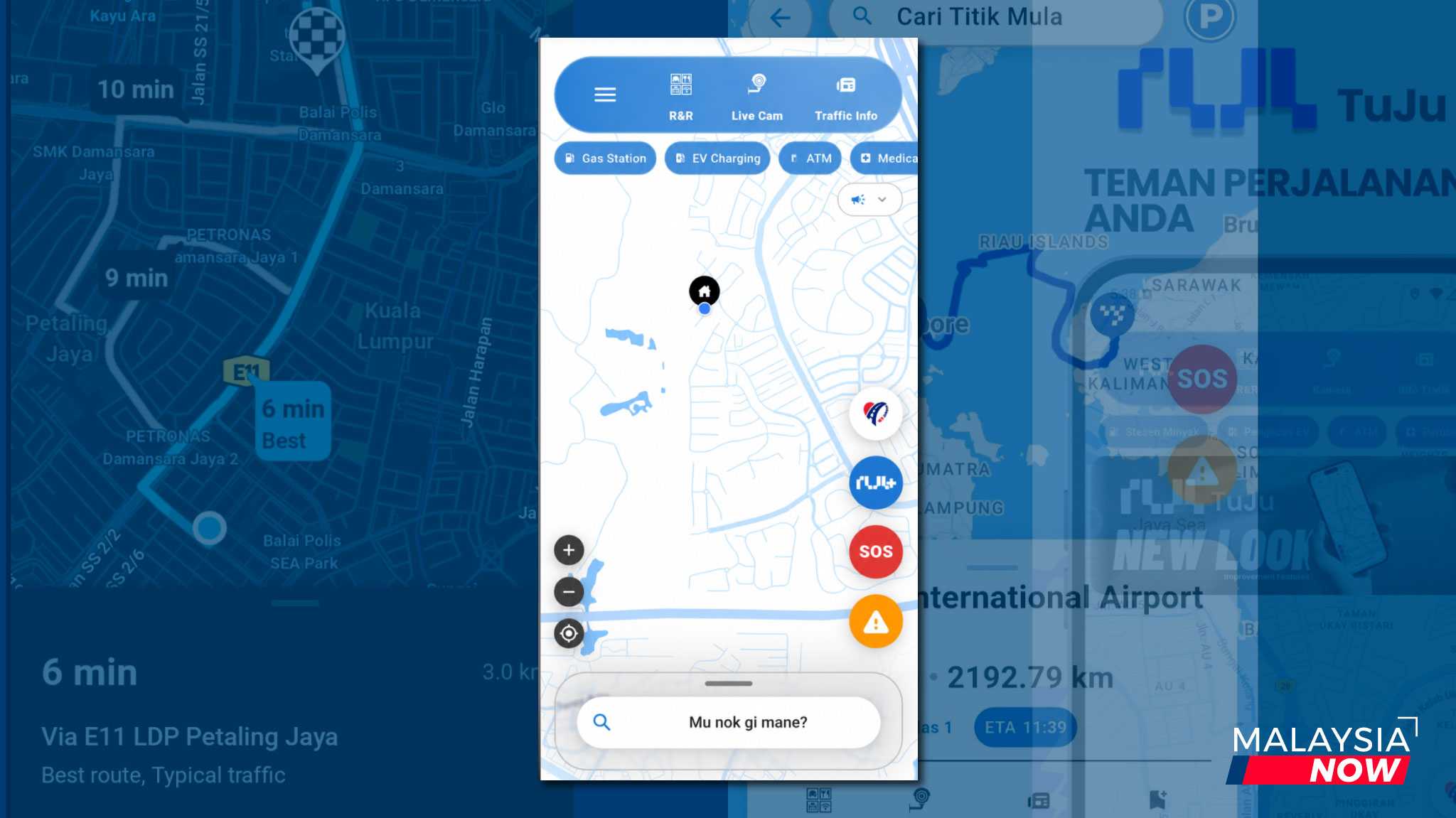
Unreliable directions, missing CCTV feeds, search problems, lack of GPS and complete freezes.
Welcome to TuJu, a GPS navigation app owned by the Malaysian government and launched last year after three years of development.
TuJu (which means “destination” in Malay) was developed by the government’s Highway Authority (LLM) in collaboration with Prosignal Consortium Sdn Bhd.
But it was almost never heard of, let alone used by Malaysians, who are accustomed to apps such as Waze and Google Maps for their daily driving – until a sudden announcement by none other than the prime minister himself, advising Malaysians to use the local app instead.
The reason is that Waze, which has Israeli origins and operates under Israeli laws, has been flagged by the National Security Council for data sovereignty risks and for exposing user location and movement patterns.
“Sensitive government information and Malaysians’ personal data must be protected from exploitation by the Israeli regime in ways that could jeopardise the country’s security and sovereignty,” said Prime Minister Anwar Ibrahim.
This was followed by the government’s ban on civil servants using Waze and its call for Malaysians to switch to TuJu.
The announcement sent thousands of Malaysians to download the app from Google’s Play Store and Apple’s App Store.
When launched, TuJu displays a welcome message in different Malay dialects and slang, perhaps hoping to put a smile on the user: “Mu nak gi mano?” says one, using the Kelantanese dialect, which means “Where do you want to go?”
But few users have been amused, even long before Anwar's announcement.
On Google’s Play Store, users have given TuJu a low cumulative rating of 2.1 out of 5 stars.
At the heart of the complaints is TuJu’s main supposed function: road directions.
“It cannot find searched location and cannot pinpoint location on map, so how am I going to that location?” asked Mazlan MS in a comment posted in August.
On the App Store, Nadia Gonzales, in a review on July 30, said the app did not adequately display traffic conditions and that its map repeatedly flickered.
“Doesn’t really show how the traffic is, basically it just shows route on the map,” she wrote.
She also warned that because the app is excessively slow, motorists could miss a turn while waiting for the map to recentre.
MonstazI is another disappointed user who was initially excited to show his patriotism.
“I really want to support local products, but if the current result gives me a bad experience or rating, I hope the team can consider improving it with new features and many more useful functions,” he wrote in an App Store review.
IT and gadget news site SoyaCincau listed findings of its own testing on TuJu: confusing turn-by-turn instructions, a lack of lane guidance at junctions and the absence of Android Auto and Apple CarPlay support.
“Things get worse when navigating complicated roads around Kuala Lumpur and the Klang Valley, where multiple highway ramps and exits can be located close to each other,” it said.
“We encountered situations where we needed to keep far left to take the correct exit, but TuJu continued telling us to keep straight.”
Another recurring complaint concerns access to highway CCTV feeds, which motorists use to check traffic conditions before setting off.
“Don’t know who the heck developed and maintaining this app, but they sure are lousy at their job especially on the highway cctv features,” according to a Play Store review left by Raffi Alwi, who said the feeds appeared to work on other apps.
RenE AWP, in a one-star review, said the CCTV feeds failed to load in the morning: “Sucks big time... they don’t even load the feeds in the morning. How the heck I am to plan my morning journey.”
According to TuJu’s developer, the app draws on information from LLM, highway operators, crowd-sourced contributions and other data sources to provide traffic updates and road-related information.
Successful alternatives in other countries
Malaysia is not the first country to flag Waze over user data sovereignty.
Over the years, many countries have developed their own alternatives, with the popularity of the local apps a testament to their reliability.
Some of the most prominent domestic alternatives to Waze and Google Maps are found in countries that have developed their own IT infrastructure independent of Western giant corporations.
In China, apps such as Alibaba’s Gaode Map are among the most popular, alongside others such as Baidu and Tencent.
In Russia, Yandex is considered the market leader, surpassing Google Maps and Waze. It has a detailed urban directory and offline map application, providing even exact building entrances.
In Iran, the Neshan and Balad apps are highly rated, and feature real-time traffic data, speed camera alerts and police checkpoint warnings, and their features are integrated into local ride-hailing apps like Snapp and Tapsi. On the Play Store, Neshan has a rating of 4.8, while Balad boasts a full 5-star rating.
Meanwhile in Malaysia, even when faced with a deluge of complaints for months on both the Google and Apple app download sites, there was no direct response from LLM or Prosignal Consortium to users.
Now, as the complaints spill over to social media, LLM has issued a one-page statement.
“LLM apologises for the difficulties experienced by users. LLM, together with the application developer, Prosignal Consortium Sdn Bhd (PCSB), is taking immediate action to identify the root causes of the issues, restore system stability and improve the application’s capacity to accommodate the increase in users.
“At the same time, LLM is paying close attention to user feedback regarding navigation functions, traffic information and the overall user experience.”
...


Read the fullstory
It's better on the More. News app
✅ It’s fast
✅ It’s easy to use
✅ It’s free