History maketh us what we are today

7 hours ago
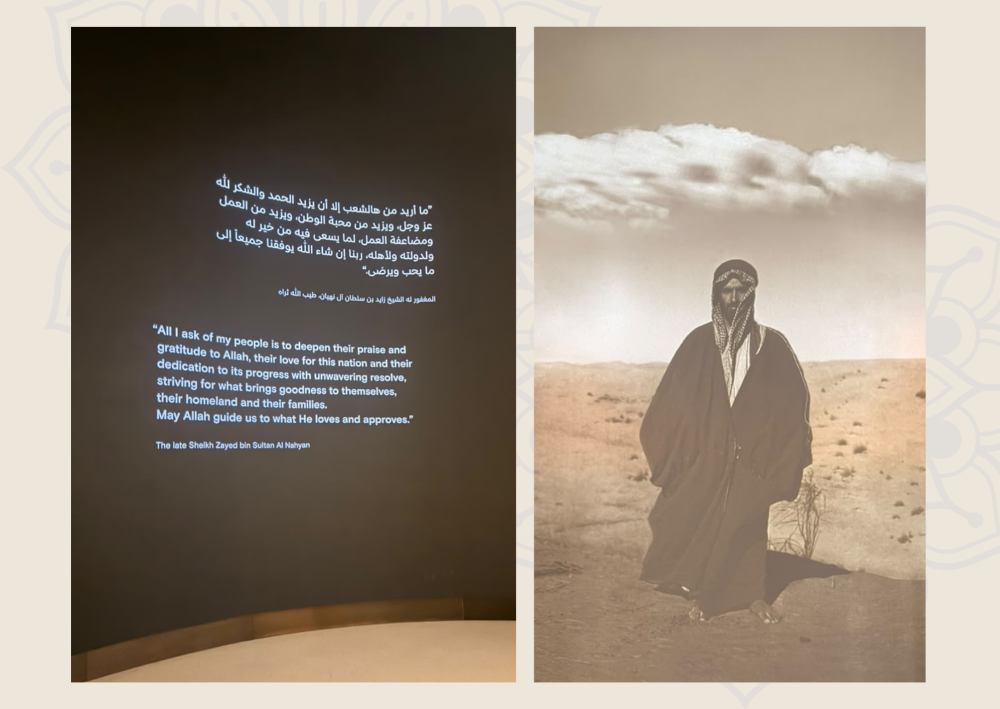
I THOUGHT I was going for a leisurely afternoon at a museum in Abu Dhabi. I came away thinking about Pahang, our rulers, our young people and the research journey I am about to begin.
At Zayed National Museum, a panel bearing the heading “The journey continues” caught my attention. On it were words attributed to the late Sheikh Zayed bin Sultan Al Nahyan:
“A nation without a past is a nation without a present or future.”
I stopped to read them.
For years, I have expressed a similar conviction in my own words: history maketh us what we are today. Here, far from home, I found that thought expressed by a ruler whose vision helped bring a nation into being.
What moved me was the relationship between those words and everything I had just seen.
The photographs allowed me to follow Sheikh Zayed’s work in developing the emirates. They preserved moments through which younger generations could discover the man, his leadership and the beginnings of their country. Looking at them, I thought about the wisdom and patience required to bring rulers together around a shared future.
Sheikh Zayed never forgot his roots. As I followed the story of his leadership, I was struck by how his vision for the future remained grounded in the land, traditions and people from which he came. The museum carries that lesson forward: progress can go hand in hand with a deep attachment to one’s heritage.
I was glad to see that the museum gave Sheikha Fatima bint Mubarak, the Mother of the Nation, her own place in the story. She drew inspiration from Sheikh Zayed and brought her own vision and determination to opening opportunities for Emirati women. As Sheikh Zayed worked to bring the emirates together, Sheikha Fatima helped shape what that shared future would mean for women and their families.
The woman beside Sheikh Zayed was remembered for her own contribution. What stayed with me was her understanding of the importance of health and education. Building a nation also means caring for its people and giving them opportunities to learn.
The UAE was formed in 1971, initially with six emirates, with Ras Al Khaimah joining the following year. Yet the museum’s account reaches back some 300,000 years into the human history of the land.
What I encountered was a nation proud of its heritage and determined to share it. Although the federation is young, the history of human life in the place its people call home reaches deep into the past.
That distinction stayed with me. The date on which a country takes its modern political form is one moment within a much longer history.
The archaeological displays fascinated me. So did the traditional falaj water systems and the reconstructed Magan Boat, which reminded me of our maritime museum in Pekan. I thought about the knowledge involved in building vessels, understanding winds and currents, and navigating across the sea. An afternoon’s walk had opened up questions about how people lived, travelled and exchanged knowledge across generations.
But it was Sheikh Zayed’s understanding of the importance of the past that remained foremost in my mind.
The UAE’s development impressed me. So did its commitment to preserving the memory of its beginnings. Amid the achievements of the present, the museum invites younger generations to consider the lives and work that preceded their own, especially the contribution of Sheikh Zayed.
I thought of Muzium Negeri Pahang. Our museum is smaller, and we do not have the same financial resources for a building on this scale. Yet we, too, have a rich history deserving care and attention. Our collections hold stories, manuscripts, objects and memories through which our people can come to understand their inheritance.
A museum’s importance cannot be measured by the grandeur of its building alone. We must also ask what visitors discover there, what they come to understand, and whether they leave wanting to know more.
Our history extends far beyond the formation of the modern nation. My thoughts wandered to Kedah and Lembah Bujang, the Perak Man, Kota Gelanggi, and the wider worlds of Srivijaya, Majapahit, Langkasuka and Champa. I thought of our Batu Bersurat and legal manuscripts, including Hukum Kanun Melaka, different forms of evidence through which we encounter earlier lives and ideas.
Then, inevitably, I thought of Melaka and Parameswara.
My study of Hukum Kanun Pahang has made me increasingly conscious of how much can be carried forward through law, institutions and ideas of government. A manuscript can preserve understandings of authority and responsibility that deserve to be read carefully, within the circumstances in which they were written and used.
This is why Parameswara remains in my thoughts. For me, the question of his legacy opens a larger enquiry into Malay kingship: the political tradition associated with Melaka, the ways later rulers understood their inheritance, and the decisions through which they sustained or reshaped it.
The fall of Kota Melaka does not bring that enquiry to an end. It prompts us to ask where its traditions travelled, how they changed and what later generations preserved.
These questions have followed me from my master’s into the research I now hope to undertake.
As I considered Sheikh Zayed’s vision of union, my thoughts also turned to our Conference of Rulers.
The UAE and Malaysia have different histories and constitutional arrangements. Nevertheless, seeing the story of rulers coming together made me reflect on our nine Malay rulers and their place within our federation.
In Malaysia, the Conference of Rulers forms part of our constitutional monarchy and parliamentary democracy. Its history connects the Malay sultanates with our constitutional present. It invites us to consider the relationship between the states and the nation, and how inherited institutions continue to carry responsibilities in contemporary government.
To understand those institutions fully, surely we must take an interest in the history from which they emerged.
Professor Anthony Milner made an observation that has stayed with me: modern Malaysian government and politics are often discussed with little reference to their Malay heritage. His words helped sharpen a question I was already carrying. How much might we miss when we examine our present without sufficient knowledge of its past?
That question gives purpose to my proposed PhD:
Malay Kingship and the Legacy of Parameswara in an Age of Empire: A Comparative Study of Sultan Ahmad Al Muadzam Shah of Pahang, Sultan Abu Bakar Al Mansur of Johor and Sultan Idris Murshidul Shah of Perak.
I want to examine these three rulers together because their differences raise questions that matter to me. What did each understand his responsibilities to be? What traditions did he inherit? What choices were available to him, and how did he respond to the circumstances he faced?
The comparison will require attention to their different political settings and relationships with British power. It will also require me to look closely at their own actions, purposes and understandings of kingship.
These three rulers also belong to my children’s family history. Sultan Ahmad is my husband’s paternal great-great-grandfather, and Sultan Idris his maternal great-great-grandfather. Sultan Abu Bakar is my own great-great-grandfather. I want my children to understand their lineage and the historical significance of their ancestors: the responsibilities they carried, the decisions they made and the part they played in shaping the states we know today. That family connection gives me a further responsibility to study their lives carefully and allow the evidence to guide my understanding.
In this, I felt a personal connection with the purpose of Zayed National Museum: preserving Sheikh Zayed’s story for his descendants and future generations, so that they may understand their inheritance and remember the responsibilities that come with it. I hope my research will help my children understand their own ancestors with the same sense of gratitude and responsibility. Their history deserves to be known, understood and passed on.
I begin with curiosity. The answers must come through research.
Perhaps that is why the museum visit affected me so deeply. It reminded me of the relationship between preserving evidence and making it meaningful to those who come afterwards.
Young people cannot be expected to appreciate a history they have had little opportunity to discover. We must help them encounter it, ask questions of it and understand why it matters. Pride has firmer foundations when it grows from knowledge.
The museum’s programme book showed the thought given to that task. There were stories and activities for children, opportunities for families to explore together, and programmes designed to welcome visitors with different needs. These were practical ways of bringing more people into contact with their shared inheritance.
There was another moment that made me especially happy: meeting a Malaysian curator who told me she had completed her bachelor’s degree at IIUM and her master’s at ISTAC.
An alumna!
As Constitutional Head of IIUM, I felt proud. Here was someone educated in our Garden of Knowledge and Virtue contributing to the understanding of another country’s heritage. That unexpected encounter brought a little of home into my afternoon in Abu Dhabi.
I left grateful for what I had seen, and with renewed affection for our own museums and those who work to preserve our history.
Every nation has a past. Keeping knowledge of it alive takes care, scholarship and a willingness to pass it on. We owe younger generations the opportunity to understand the world they have inherited, including the lives and decisions that helped shape it.
Sheikh Zayed’s words expressed something I have long believed. My visit gave me fresh reason to pursue it.
History maketh us what we are today.
And as I prepare to take the next step in understanding our own, the words at the top of that museum panel feel particularly fitting.
I imagine a young Malaysian asking, “What did the people who came before me build, and how does it still shape the country I live in today?"
For my children, it might be more personal. “Mama, we know their names. What did they do, and why does it still matter?"
Sheikh Zayed said "Our society's deep rooted values should remain a constant guiding light for our unity, solidarity, respect for others and support passed down from generation to generation."
As for me, the journey continues …
Tunku Azizah Aminah Maimunah Iskandariah holds a master’s degree from the International Institute of Islamic Thought and Civilisation (ISTAC), International Islamic University Malaysia and currently a PhD candidate at ISTAC-IIUM.
...


Read the fullstory
It's better on the More. News app
✅ It’s fast
✅ It’s easy to use
✅ It’s free