Sharpa puts robotic dexterity to the test at CIIE 2026

9 hours ago
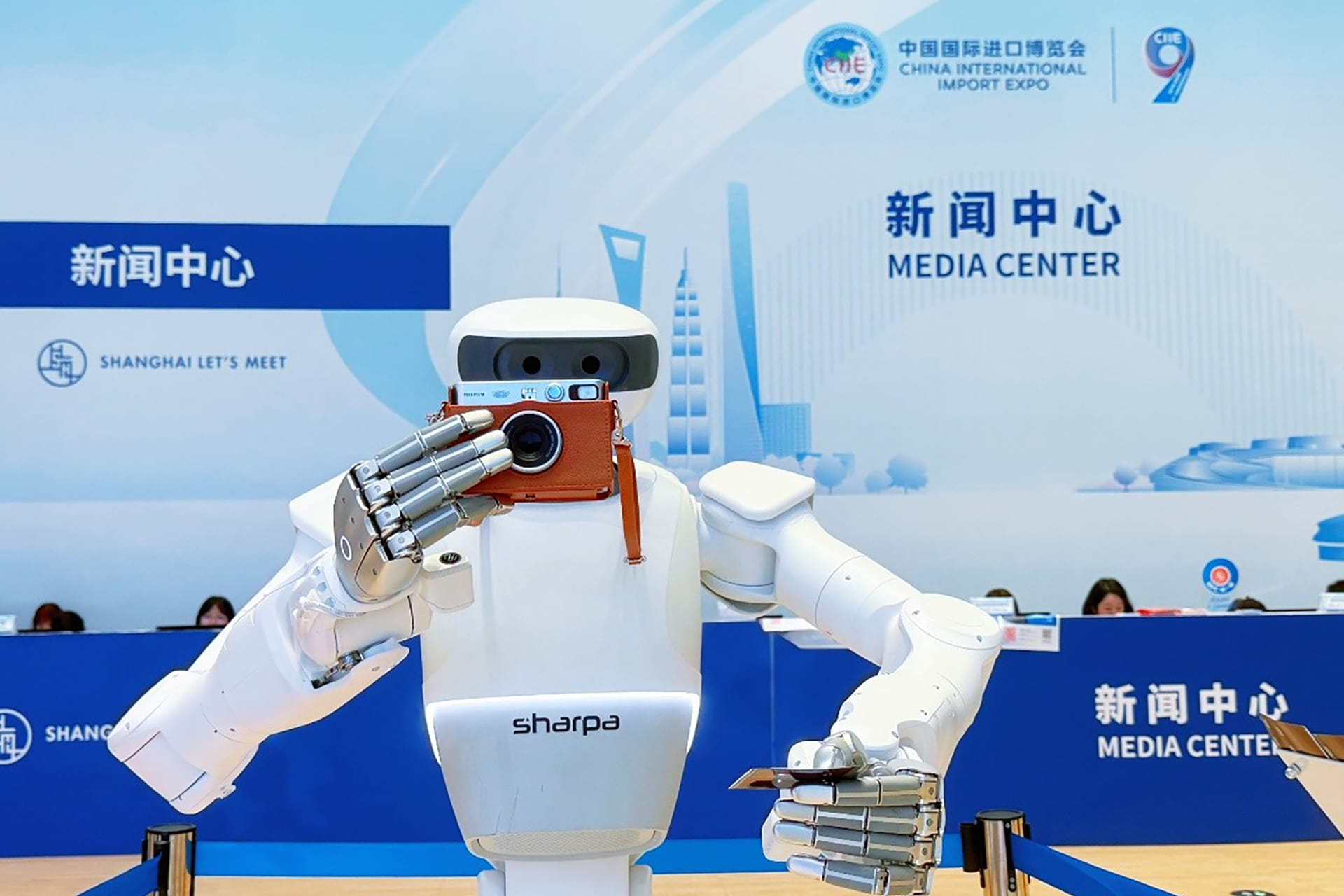
A photo is a small souvenir. For a robot, however, taking one involves a sequence of precise tasks.
At its first appearance at the China International Import Expo (CIIE), Sharpa offered an autonomous photography service at the ninth edition’s press center. Its robot picked up an instant camera, adjusted its grip, aimed, pressed the shutter, and handed the photograph to visiting journalists.
Serving reporters from around the world requires the robot to repeat that sequence reliably throughout the day.
Operating the camera requires the robot’s fingers to move with a precision of two millimeters.
The robot adjusts its position and applied force in real time. Vision and hand-eye coordination guide its movements, while tactile sensing helps it detect contact with the camera and control how firmly it grips or presses.
The task goes beyond picking up an object or demonstrating an isolated hand movement. The robot must use a tool designed for people and complete the sequence, including handing over the finished photo.
The ability to use existing tools also matters in food service and retail, where operators need robots to work with their equipment and processes.
Sharpa is testing that ability at a Dairy Queen restaurant on Wujiang Road in Shanghai’s Jing’an district.
At the restaurant jointly developed by the two companies, a robot performs a 55-step sequence, from ordering to preparing and handing over a Blizzard. According to Sharpa, it operates during the restaurant’s daily business hours, from 10 a.m. to 10 p.m, without continuous human control.
Sharpa said the system requires no modifications to the existing equipment or preparation environment. It carries out the full workflow autonomously and is designed to operate during scheduled opening hours year-round.
Dairy Queen’s standardized equipment, ingredients, processes, and quality requirements test the robot’s ability to produce consistent results throughout a working day. The operating restaurant also allows Sharpa to assess whether its robots can handle complex tasks reliably in an existing workplace and adapt to other commercial settings.
Sharpa is developing control systems and hardware to perform everyday tasks and reduce the time people spend on them.
In 2025, it introduced the Sharpa Wave W01 dexterous hand. At this year’s IROS robotics conference, it unveiled three additional products: the D01, an integrated robot for dexterous manipulation with tactile sensing; the W02, an ultracompact, lightweight hand with tactile sensing throughout; and the AE01, a high-fidelity haptic exoskeleton glove for collecting manipulation data.
Together, the products cover whole-body movement, hand manipulation, and the collection of human manipulation data. Sharpa said it develops its data collection equipment, dexterous hands, and robot hardware in-house to connect data collection, decision-making, and physical action.
Sharpa plans to deploy 30,000 robots, focusing on food service, retail, and hotels. It intends to use data gathered from real-world tasks to improve how the robots adapt to different tools, environments, and workflows before expanding into more industries and homes. The photographs and ice cream are early tests of that ambition.
This article was adapted based on a feature originally written by Stone Jin and published on IPO Zaozhidao. KrASIA is authorized to translate, adapt, and publish its contents.
...


Read the fullstory
It's better on the More. News app
✅ It’s fast
✅ It’s easy to use
✅ It’s free