Argentina’s Falklands banner reignites political tensions after World Cup win over England

1 hour ago
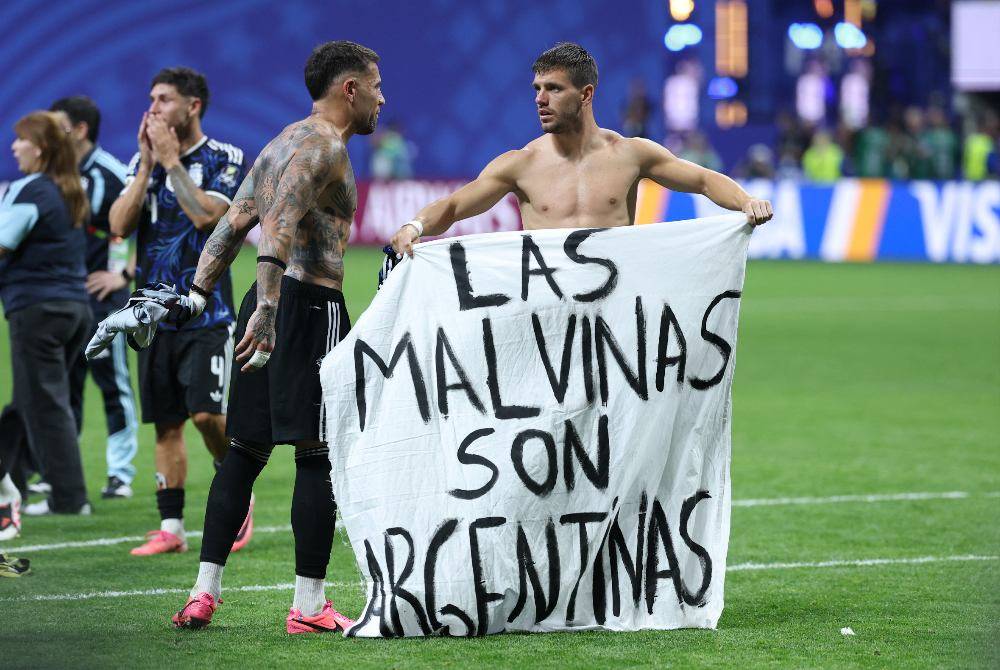
SHAH ALAM - Argentina's celebrations after their 2-1 FIFA World Cup semi-final victory over England have drawn fresh scrutiny after players displayed a political banner declaring "Las Malvinas Son Argentinas" (The Falklands are Argentinian), raising questions over FIFA's rules prohibiting political messages inside stadiums.
Following Wednesday's victory, Argentina defenders Lisandro Martinez and Giovani Lo Celso were photographed holding and waving the banner towards supporters inside the stadium.
The message refers to the Falkland Islands, known in Argentina as Las Malvinas, a British Overseas Territory that has remained the subject of a decades-long sovereignty dispute between the United Kingdom (UK) and Argentina.
The display appeared to conflict with FIFA's Stadium Code of Conduct, which prohibits political material inside stadiums.
According to FIFA's regulations, "banners, flags, flyers, apparel and other paraphernalia that are of a political, offensive, and/or discriminatory nature" are banned during matches.
As of publication, FIFA had not publicly commented on the incident.
The banner came after an emotionally charged build-up to the semi-final, with the historical dispute over the Falkland Islands once again becoming intertwined with football.
Following Argentina's Round of 16 victory over Egypt, players were filmed celebrating while singing: "For the Malvinas, for Diego, for Leo's last one."
The chant references three enduring symbols for many Argentinians — the Falkland Islands (Las Malvinas), late football legend Diego Maradona and captain Lionel Messi, who is widely expected to be playing in his final World Cup.
The Falkland Islands are an archipelago in the South Atlantic Ocean, located about 300 miles from Argentina's coast.
Britain has administered the islands as a British Overseas Territory since 1833, while Argentina has consistently maintained its claim over the territory, arguing sovereignty passed to Buenos Aires following independence from Spain in 1816.
The dispute escalated into armed conflict in 1982 when Argentina's military government invaded the islands in an attempt to seize control.
The 74-day Falklands War resulted in the deaths of 649 Argentine military personnel, 255 British servicemen and three Falkland Islanders before Britain regained control of the territory.
Today, the islands' population of around 3,700 overwhelmingly identifies as British and has repeatedly expressed its desire to remain under British sovereignty.
The historical dispute has remained deeply embedded in Argentine national identity and football culture, particularly whenever the national team faces England.
Supporters have regularly sung chants referencing the Malvinas during international and domestic matches and the latest World Cup meeting revived one of football's fiercest rivalries.
The political sensitivity surrounding the fixture also influences FIFA's referee appointments.
Under a long-standing practice informally known as the "Falklands rule", English referees are not appointed to Argentina matches, or matches with direct implications for Argentina's tournament progression and vice versa.
The policy previously prevented English referee Anthony Taylor from officiating the 2022 World Cup final between Argentina and France, despite being regarded as one of the tournament's leading candidates.
Ahead of this year's semi-final, Atlanta police reportedly increased security around the match due to the historic tensions between supporters of both nations.
Political rhetoric also surfaced before kick-off, with Argentina's vice-president referring to England as "invaders" and "usurping pirates", further intensifying attention surrounding the encounter.
However, not all groups in Argentina supported linking football with the sovereignty dispute.
The April 2 War Veterans Federation urged supporters to separate sport from politics, saying: "Sport is not war: The semi-final match is a global sporting event, not an armed rematch or a form of historical redress."
England and Argentina share one of football's most storied rivalries, shaped by both sporting drama and political history.
Their most famous World Cup meeting came in 1986 when Diego Maradona scored the infamous "Hand of God" goal before producing one of the tournament's greatest solo efforts to eliminate England.
Argentina again defeated England on penalties at the 1998 World Cup after a dramatic 2-2 draw, while England gained revenge in the 2002 group stage through David Beckham's penalty.
This year's semi-final marked the first competitive World Cup meeting between the two nations in more than two decades.
...


Read the fullstory
It's better on the More. News app
✅ It’s fast
✅ It’s easy to use
✅ It’s free