Chinese appliance makers bolster Europe push, eye vertical integration
1 hour ago
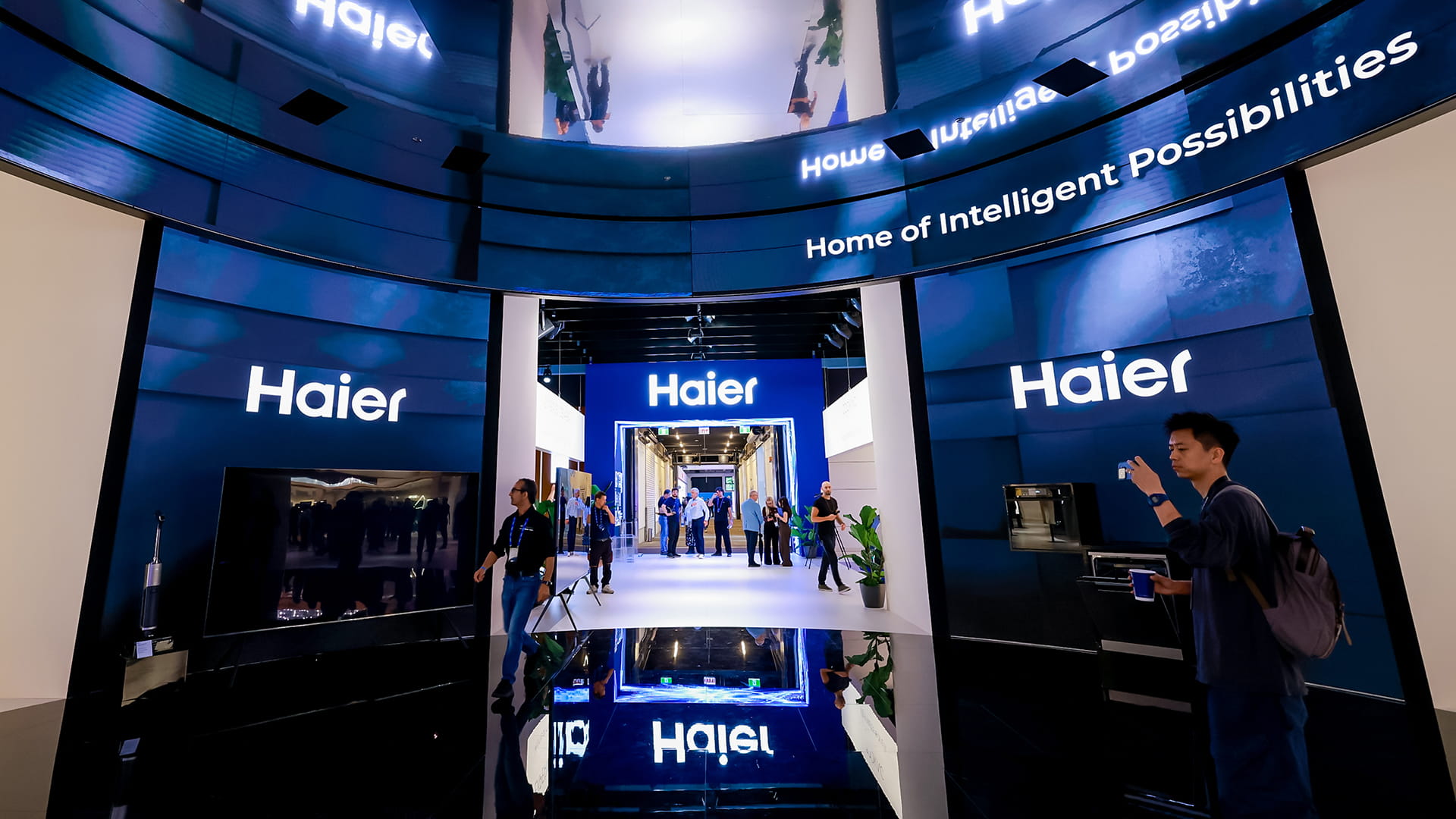
Chinese appliance makers like Haier Group are taking Europe by storm, leveraging local acquisitions to grab a 20% share of the washing machine and refrigerator markets as European regulators rush to tap the brakes on their expansion.
Haier Europe held a media event in Berlin on September 3, ahead of IFA, one of Europe’s largest consumer electronics and home appliance trade fairs. CEO Neil Tunstall said the company aims to become the first choice for smart homes among European consumers.
At the event, Haier unveiled an artificial intelligence-powered dishwasher that optimizes washing methods to improve energy efficiency by up to 70%, as well as technology that lets users monitor the contents of their refrigerator in real time through a mobile app.
The company also announced plans to invest EUR 13 billion (USD 15.1 billion) in R&D over the next five years.
Haier made a full-fledged expansion in Europe during 2019, when it acquired Italian appliance maker Candy for EUR 475 million (USD 552.6 million). The deal gave Haier ownership of locally well-known brands like Hoover vacuum cleaners, providing a foothold in the region.
Other Chinese manufacturers also are using acquisitions to build their European presence. Hisense bought Slovenian washing machine and dishwasher maker Gorenje in 2018, while Midea Group purchased Germany-based Teka Group in 2025, adding expertise in sinks and other plumbing fixtures and appliances.
Chinese companies have strengthened their position in Europe over the past decade by responding to demand for energy-efficient products and smart-home technologies, Euromonitor International’s Veronika Kandusova said.
Haier and Hisense’s combined share of Europe’s washing machine market soared from 2.9% in 2016 to 20.5% in 2025, Euromonitor reports. Their share of the refrigerator market similarly climbed to 18.7% from 5.6%.
Their rapid expansion has put them in direct competition with local players—like BSH Hausgerate, owned by Germany’s Bosch, and Sweden’s Electrolux—that have struggled to differentiate themselves from Chinese rivals offering competitive prices.
But China’s advantage is expanding beyond low prices. Startups also are making a strong showing at IFA 2026.
Roborock, the global leader in robot vacuum cleaners, unveiled an underwater device that removes dirt and debris from pool floors and walls. The company is targeting North American and European households, where private pools are relatively common, aiming to launch the product in 2027.
Roborock also showcased a robot vacuum equipped with leg-like components capable of climbing stairs. Unlike many European manufacturers, whose products focus on functional improvements, the company highlighted its ability to develop innovative products based on unconventional ideas.
Chinese companies also look to secure control over major European consumer electronics retailers.
In July 2025, e-commerce player JD.com announced plans to acquire German retail group Ceconomy, operator of electronics chains MediaMarkt and Saturn, in a deal valuing the company at EUR 2.2 billion (USD 2.6 billion). JD.com believes that its expertise in integrating online and physical retail operations will be of value to Ceconomy, and it also hopes to deepen logistics cooperation.
But European authorities are increasingly wary of Chinese efforts to establish vertically integrated models that extend from product development and manufacturing to retail distribution.
The European Commission announced an investigation in May over whether JD.com had benefited from Chinese government subsidies or preferential treatment in ways that distorted fair competition within the European Union. China responded last month by saying the probe constituted “improper extraterritorial jurisdiction,” arguing that it extended into activities within China.
Chinese companies occupy some of the largest booths at this year’s IFA, while Japanese firms have little visible presence. South Korea’s Samsung Electronics moved its booth to a separate venue away from the main exhibition grounds, highlighting how dramatically the industry’s center of gravity has shifted.
This article first appeared on Nikkei Asia. It has been republished here as part of 36Kr’s ongoing partnership with Nikkei.
Note: EUR figures are converted to USD at rates of EUR 0.86 = USD 1 based on estimates as of September 10, 2026, unless otherwise stated. USD conversions are presented for ease of reference and may not fully match prevailing exchange rates.
...


Read the fullstory
It's better on the More. News app
✅ It’s fast
✅ It’s easy to use
✅ It’s free