Huawei brings near-packaged optics to AI with Atlas 960E superpod
1 hour ago
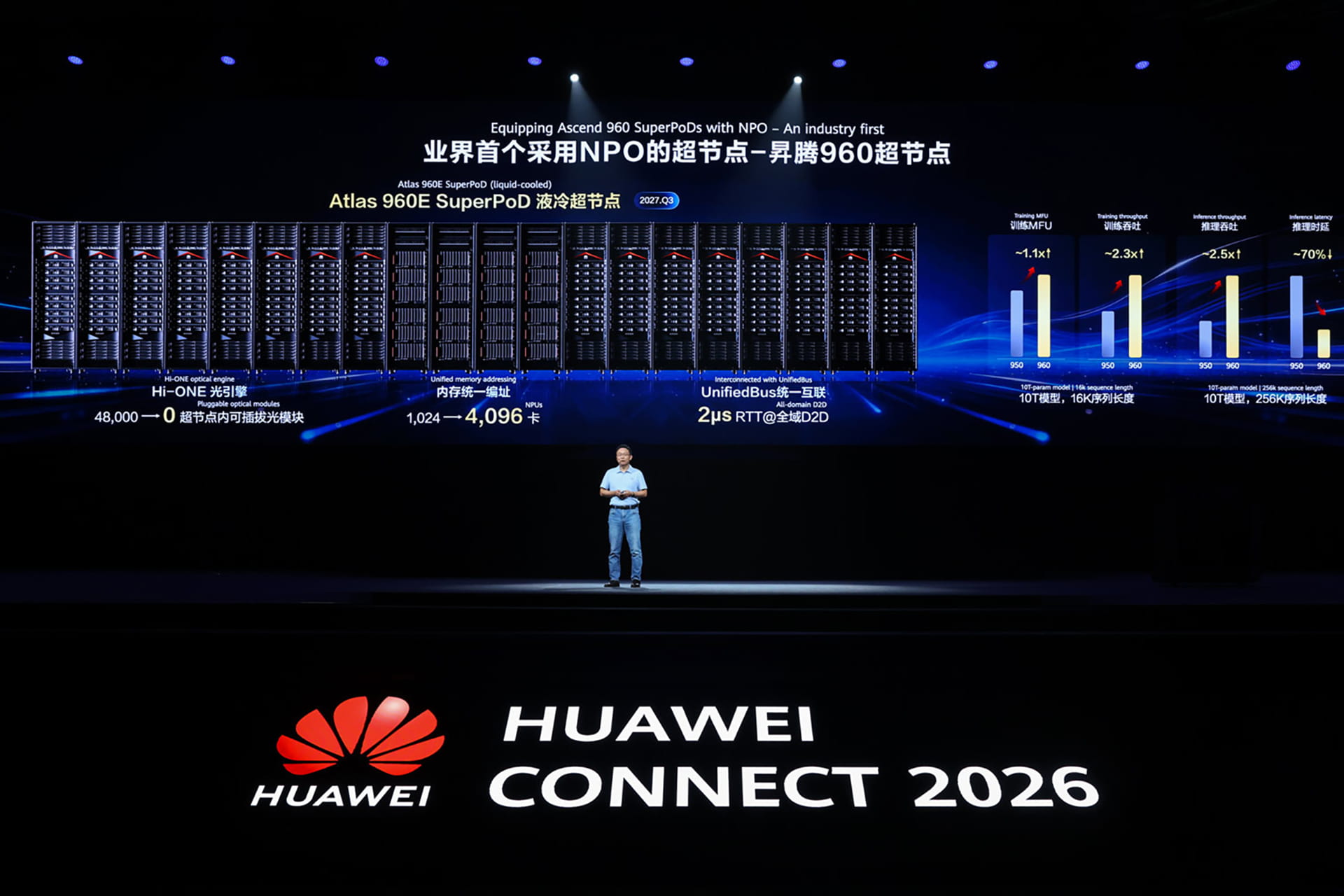
Huawei has unveiled the Atlas 960E superpod, an artificial intelligence computing system designed to link up to 4,096 neural processing units (NPUs) using near-packaged optics (NPO). The system targets a growing constraint on AI performance: moving data between chips without consuming too much power.
Announced at Huawei Connect 2026 in Shanghai on September 17, the Atlas 960E combines Huawei’s UnifiedBus interconnect with its high-density optical interconnect node engine, or Hi-ONE. Huawei said a single system can deliver eight exaflops at FP8 precision and contain up to one petabyte of high-bandwidth memory.
Huawei said Hi-ONE provides 7.2 terabits per second of transmission capacity. The company described the product as the industry’s first NPO engine ready for mass production and the first with an integrated light source. According to Huawei, the Atlas 960E uses 5,500 engines in place of 48,000 conventional 800G optical modules, reducing power consumption by more than 550 kilowatts. Huawei also claims twice the fault-free operating time and 99.8% system availability.
Huawei has also proposed an NPO implementation agreement to the Optical Internetworking Forum (OIF), an industry standards body, as it seeks to establish an interoperable ecosystem around the technology. The proposal has yet to become an OIF standard.
Adding processors does not necessarily produce a proportional increase in usable computing power. As AI clusters grow, their accelerators must exchange more data, and time spent waiting for those transfers can erode the gains from additional chips.
Huawei said communications can account for more than 40% of training time in conventional server-based clusters. UnifiedBus is intended to reduce that overhead by replacing multiple interconnect protocols with a common protocol and reducing the need for conversion between them.
Scale-up networking tightly connects processors within a computing domain so they can operate as parts of one larger machine. Scale-out networking links separate servers or systems into a larger cluster. Both face communications bottlenecks, but their requirements differ.
NPO places optical engines closer to switching chips, shortening the electrical path before signals are converted into light. In Huawei’s design, optical links support connections across cabinets, while UnifiedBus provides a common interconnect architecture for the computing system.
In the Atlas 960E, Huawei applies NPO within a tightly connected 4,096-NPU system. Optical networking itself is not new to Huawei’s superpods, but NPO changes how closely the optical components are integrated with the switching hardware.
Nvidia and Broadcom have taken a different approach with co-packaged optics (CPO), which brings optical engines alongside switching silicon in a common package. Nvidia’s Spectrum-X Ethernet Photonics has reached production, while Broadcom has already commercialized CPO switches. These designs shorten the electrical portion of the connection before data is converted into optical signals, addressing many of the bandwidth and power constraints targeted by Huawei.
NPO stops short of integrating the optical engine into the chip package, instead placing the components nearby on the printed circuit board. CPO’s tighter integration reduces signal loss and enables high bandwidth density, while Huawei argues that NPO can be easier to manufacture and service using existing supply chains.
Huawei told Nikkei Asia that its NPO components are pluggable, allowing a defective component to be replaced independently. Hi-ONE combines a laser source, silicon photonics, and other chips. Serviceability varies across CPO designs: Nvidia uses field-replaceable external laser modules, and its Quantum-X Photonics design includes socket-based optical subassemblies.
“NPO is a more practical choice compared with CPO,” Man Jiangwei, an executive at Huawei’s HiSilicon advanced optoelectronics laboratory, told Nikkei Asia. Huawei also sees fragmentation among NPO implementations as a reason to pursue a common specification.
Tiger Ninomiya, an OIF official involved in energy-efficient interfaces and co-packaging interoperability, told Nikkei Asia that NPO could serve as an evolutionary step toward CPO while addressing current manufacturing, interoperability, and ecosystem concerns.
The Atlas 960E sits within Huawei’s broader Peerium computing architecture. Peerium uses UnifiedBus to connect CPUs, NPUs, memory, solid-state drives, network interface cards, and switches through a common protocol. It combines peer-to-peer interconnection and unified memory addressing with a parallel computing method Huawei calls Nested Bulk Synchronous Parallel, or Nested BSP.
Huawei said a Peerium-based Atlas 950 supercluster with 256,000 accelerator cards is being deployed. The company ultimately aims to make up to one million processors operate as one logical computer.
Huawei began developing UnifiedBus in 2019 and delivered its first UnifiedBus 1.0-based Atlas 900 A3 superpod in March 2025. The company said in 2025 that its lack of access to advanced semiconductor process nodes contributed to its decision to pursue performance gains by combining more computing resources.
Huawei also upgraded its TaiShan 950 superpod, which reportedly supports up to 4,096 general-purpose computing nodes and a unified memory pool of up to 256 terabytes. It introduced the OceanStor M900, a storage system offering petabyte-scale key-value (KV) caching for AI inference. KV caching stores intermediate attention calculations so a model can reuse them when generating subsequent tokens.
According to Huawei, its two-tier, four-plane Clos network architecture can connect up to 512,000 NPUs across superpods. A multi-rail topology, which provides multiple network paths, can extend that design to one million NPUs, the company added.
Huawei also updated its Ascend processor roadmap, scheduling the Ascend 960DT for the first quarter of 2027 and the Ascend 960PR for the third quarter, followed by the Ascend 970 and Ascend 980 in 2028 and 2029, respectively.
...


Read the fullstory
It's better on the More. News app
✅ It’s fast
✅ It’s easy to use
✅ It’s free