What the West's stumbling democracies can teach Malaysia

9 小时前
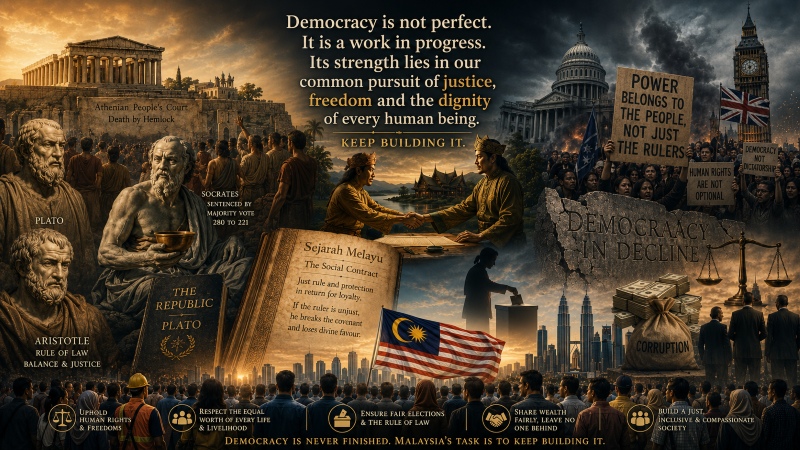
Democracy is the worst form of government except for all the others. – Winston Churchill
Britain’s wartime prime minister, Winston Churchill, probably wasn’t the first to say this. But he made it famous. The quote still stands as a rather sad verdict on the state of democracy today.
Plato was one of democracy’s earliest critics. He thought it was a poor form of government. His teacher, Socrates, had been condemned to death by the Athenian People’s Court. The charge: defiling the Greek gods and corrupting young minds.
The court delivered its verdict, 280 votes to 221. Socrates was sentenced to die by drinking hemlock.
One could say this reveals a fatal flaw in democracy: the reliance on majority rule.
Plato’s answer was the idea of philosopher-kings. He set this out in his classic work, The Republic. In short, only those with great wisdom should hold key roles and become guardians of the state.
Aristotle, Plato’s student, saw the answer differently. He proposed the idea of polity: a balanced form of government built on the rule of law. This basic principle of democracy has stayed with us to this day.
Without doubt, democracy, in its many forms, has captured the human spirit for centuries. It remains one of humanity’s most progressive political ideals.
But we should not forget that popular sovereignty was not only a Western idea. The notion that power should ultimately belong to the people, not just the rulers, is also deeply rooted in many ancient Afro-Asian traditions.
The social contractTake the Malay foundation myth. It rests on the idea of a social contract between the ruler and his subjects. This could be seen as a form of popular sovereignty, though weighted heavily towards the ruler.
The Sejarah Melayu, or Malay Annals, records this sacred bargain of loyalty between subjects and ruler. In exchange for just and caring rule, and for protection, the people offered their loyalty.
The story goes that the mythical ruler, Sri Tri Buana, agreed to protect his subjects and ensure their prosperity. He promised never to oppress or humiliate them.
In return, Demang Lebar Daun, who represented the subjects, pledged unwavering loyalty for himself and all his descendants. He agreed that none of them would ever commit treason, or derhaka, against the ruler.
The oath forbade rebellion as long as the ruler governed justly. Implied in this bargain was a moral understanding: if a ruler ruled unjustly or abused his power, he broke his side of the social contract. This meant he would lose divine favour, and calamity would befall his kingdom.
In some ways, this idea echoes Plato’s philosopher-king, with one addition: a covenant. That is close to Aristotle’s idea of justice anchored in law.
This notion of the social contract remains central to representative government today. It is the foundation of modern democracy.
Democratic decline in the WestToday, we are witnessing the decline of democracy across the West. Behind this decline is a retreat from just and ethical values. Look no further than the crude populism of US President Donald Trum, and the damage it has done to American democratic norms.
Westminster democracy in the UK has fared little better. The country has seen seven changes of prime minister since 2016.
About 10 years ago, the liberal philosopher Ronald Dworkin asked whether democracy was still possible in the United States.
His answer was a cautious yes. He put it like this:
American politics are in an appalling state. We disagree, fiercely, about almost everything. We disagree about terror and security, social justice, religion in politics, who is fit to be a judge, and what democracy is. These are not civil disagreements: each side has no respect for the other. We are no longer partners in self-government; our politics are rather a form of war.
Dworkin argued that for democracy to survive in the US, it must respect human rights and religious freedom and other forms of freedom of conscience. It must share wealth fairly, so that everyone has a real stake in the economy.
Above all, it must run its elections fairly, treating everyone as someone worth persuading.
Dworkin observed that America had failed on all these counts. Britain, he said, fared little better.
One might add a footnote to Dworkin’s argument. A decade on, American democracy has slipped even further. Human rights have all but vanished from America’s foreign policy in West Asia.
Lessons for MalaysiaMalaysia is an aspiring democracy, warts and all. The majority of political scientists who study Malaysia describe it as a semi-democracy or a soft authoritarian state, rather than a fully functioning one.
In truth, most existing democracies remain works in progress.
After the May 13 riots of 1969, Malaysia endured 22 months of ‘emergency rule’. Since then, it has held 12 general elections. Power has changed hands at both federal and state level, without a single resort to political violence. That is a remarkable record for such a diverse country.
There are lessons to learn from the West’s failing democracies, which have long been held up as models for the Global South.
As Dworkin argued, human rights and basic freedoms, especially freedom from oppression, are fundamental to any democracy. Most important of all is recognising the equal worth of everyone’s life and livelihood.
In these troubling times, as democracies falter, we must also guard against serious corruption, and the obscene accumulation of wealth by individuals and ‘corporate mafias‘, at the expense of ordinary people.
Deserving non-citizens, the millions of migrant workers and economic refugees who have been forced to make this country their home also deserve a place in the Malaysian sun.
We should not forget that Athenian democracy survived on the backs of an underclass of slaves, who made up a third of its population.
Nor should we forget that American democracy and prosperity grew on the back of millions of enslaved Africans, forced into unpaid labour.
Perhaps the real lesson is this: democracy is never finished, and Malaysia’s task now is to keep building it, not simply to copy a West that has stopped doing the same.
Johan SaravanamuttuCo-editor, Aliran newsletter10 August 2026
...


Read the fullstory
It's better on the More. News app
✅ It’s fast
✅ It’s easy to use
✅ It’s free