Jensen Huang Scandal Puts Malaysia's AI Chip Trade Under the Spotlight

17 小时前
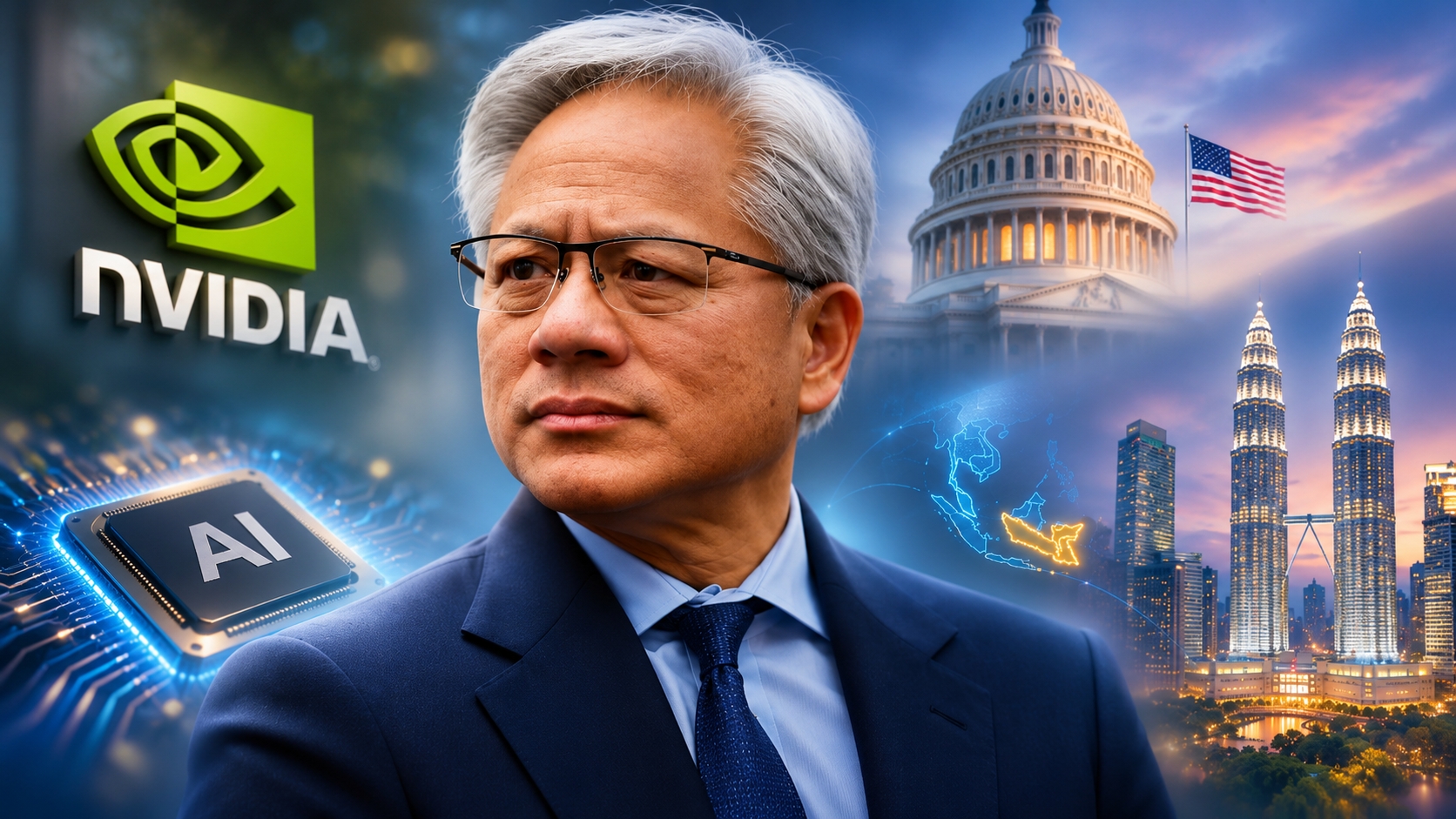
The technology powering the rapidly burgeoning artificial intelligence revolution has become one of the most strategically important commodities in the world. A relatively small number of companies control the design and manufacture of the advanced semiconductors needed to train and operate the increasingly sophisticated AI systems now being developed by governments, technology giants, and research institutions.
At the centre of this rapidly expanding industry is Nvidia, the American chipmaker whose processors have become essential infrastructure for much of the global AI boom. Its billionaire chief executive officer, Jensen Huang, is among the most influential figures in technology, and the company’s commercial success has made it one of the world’s most valuable businesses.
That position also places Nvidia at the heart of an increasingly consequential geopolitical contest. The United States has imposed restrictions on the export of certain advanced semiconductors to China, arguing that the technology could strengthen Beijing’s military and intelligence capabilities as well as its broader technological ambitions. China, meanwhile, is determined to reduce its dependence on foreign technology and develop its own advanced semiconductor industry.
Now, a controversy involving Huang’s private life, allegations of Chinese espionage, and suspected diversion of restricted Nvidia processors has brought that contest into sharper focus. And Malaysia has found itself uncomfortably close to the heart of the story.
The headlines have focused heavily on Huang’s reported extramarital relationships and the possibility that his position at Nvidia could be in jeopardy. But beneath the salacious personal drama lies a much larger and more impactful question: how effectively can the United States prevent sensitive technology from reaching restricted customers when the global supply chain is so interconnected?
It’s a complex story, and also one that’s evolving in real time, so it’s easy to be confused and overwhelmed by the various headlines and news reports. As a general explainer, however, here is some background, along with what is known, what remains unproven, and why it involves Malaysia.
WHO IS JENSEN HUANG?Jensen Huang, 63, is the co-founder, president, and chief executive of Nvidia, the company he established in 1993 with fellow engineers Chris Malachowsky and Curtis Priem.
Born in Taiwan and raised partly in the United States, Huang studied electrical engineering at Oregon State University before earning a master’s degree at Stanford. He has led Nvidia throughout its more than three-decade evolution from a graphics-chip manufacturer into one of the most important companies in the global technology industry.
Recognizable for his black leather jacket and energetic keynote presentations, Huang has become something of a celebrity in the technology world, just as several other tech company leaders have been. His appearances at major industry events attract enormous attention, and his pronouncements on the future of AI are closely followed by investors, governments, and competitors.
His influence extends beyond the company itself. Nvidia’s processors are central to the development of many of the world’s leading AI models, while its software ecosystem has helped establish the company as a dominant force in the sector.
Huang is also a substantial shareholder, owning approximately 3.6% of Nvidia. That stake, combined with his close involvement in the company’s strategy and operations, makes him particularly difficult to replace. Nevertheless, that’s now a real possibility, according to the latest reports.
WHAT IS NVIDIA, AND WHY IS IT SO IMPORTANT?Nvidia is a major American technology company best known for designing graphics processing units, or GPUs. These processors were originally developed to handle the demanding visual calculations required for computer graphics and video games.
The company’s importance grew considerably – perhaps even exponentially – when it developed software and computing architecture that allowed its GPUs to be used for much more than rendering images. Nvidia’s CUDA platform, introduced in 2006, made it possible for developers to use the company’s processors for a broad range of demanding scientific and computational tasks.
That decision proved particularly significant as artificial intelligence advanced. Training sophisticated AI systems requires enormous quantities of mathematical calculations to process data, identify patterns, and adjust the parameters that allow models to generate increasingly complex responses. These chips work diligently behind the scenes every time we engage AI.
Nvidia’s GPUs proved exceptionally well suited to this work, and the company invested heavily in developing the hardware, software, and supporting infrastructure needed to build large-scale AI systems.
Today, Nvidia is much more than a chip designer. It supplies processors, networking equipment, software, and complete computing platforms used by major cloud providers, technology companies, universities, and government institutions. It may not be as well-known at the consumer level as companies like Microsoft, Apple, and Google, but Nvidia is nevertheless a titan of the tech industry.
Its customers include some of the biggest names in technology, and demand for its products has surged as companies race to build AI infrastructure. Nvidia’s market valuation has reached approximately US$4.2 trillion, making it one of the world’s most valuable publicly traded companies. Nvidia routinely changes places back and forth with Apple as the global market cap leader.
Ironically, that level of commercial success has also made its products strategically sensitive. When access to Nvidia’s most advanced processors becomes a matter of national policy, the company’s business decisions can have consequences far beyond the technology sector.
WHAT EXACTLY ARE AI CHIPS, AND WHY DO THEY MATTER TO NATIONAL SECURITY?The catch-all term ‘AI chip’ generally refers to a processor designed or optimized to handle the enormous computational workloads involved in artificial intelligence.
Unlike conventional computer processors, which are designed to perform a wide variety of tasks in a more linear fashion, GPUs can carry out many calculations simultaneously. This parallel-processing capability makes them particularly effective at the demanding mathematical operations required to train and run large AI models.
The most advanced systems can contain thousands of individual processors working together, supported by high-speed networking and substantial memory capacity. The resulting computing power is used to develop everything from conversational AI assistants and image-generation tools to sophisticated scientific models, autonomous systems, and military applications.
Once you understand the sheer power and capability of these chips, you can see why the national security implications are considerable.
Advanced AI can be applied to intelligence analysis, cyber operations, surveillance, autonomous weapons, military planning, and the development of new technologies. A country with access to substantial computing power is more likely to be able to develop these capabilities faster and at greater scale than one without it.
That is precisely why the United States has restricted the export of certain advanced semiconductor products and related equipment to China since 2022. The controls are intended to limit Beijing’s access to computing power that could accelerate its military and strategic capabilities.
The rules have evolved, and they are not a blanket prohibition on every American chip being sold to China. Some products may be considered for export licences under specific conditions, while the more powerful and capable processors remain subject to tighter restrictions.
The Nvidia H200, for example, became eligible for case-by-case licensing under revised US rules announced in January 2026, subject to security and compliance requirements. The precise regulatory position therefore depends on the chip, the customer, the destination, and the circumstances of the transaction.
To give you an idea of how powerful the H200 GPU is, just consider its price: it’s listed in new condition at one Malaysian retailer for RM355,000. As for the actual specs, the chip has 141 GB of memory and 4.8 TB of bandwidth. Nvidia says it can deliver a whopping 3,958 teraflops, meaning 3,958 trillion AI operations per second. That’s nearly four quadrillion computational operations in a single second. That’s over 100,000 times faster than current high-end personal computers. It truly is a staggering amount of computing power.
The emerging concern now is that these restricted processors might be acquired through intermediaries, shipped to third countries, or installed in overseas data centres that subsequently provide computing services to prohibited customers.
This is where Southeast Asia, and Malaysia in particular, enters the picture. Keep reading.
WHAT IS THE SCANDAL THAT HAS PUT HUANG IN THE HEADLINES?The ongoing controversy began with reports that Huang had developed a close personal relationship with Alice Huang, a Chinese businesswoman and former executive at Megaspeed International, a Singapore-based technology company.
The two Huangs are not related.
The Wall Street Journal reported on October 30 that US intelligence officials suspected Alice Huang of having links to China’s Ministry of State Security and believed she had been recruited to cultivate a relationship with Nvidia’s chief executive. The New York Times had previously reported that US authorities considered her a Chinese intelligence asset.
According to those reports, investigators were concerned that she may have been positioned to obtain information about Nvidia and its chief executive, potentially including insights into the company’s business and its approach to American restrictions on chip exports to China.
The allegations have not been independently established in public, and Alice Huang has not been convicted of espionage. Beijing, meanwhile, has rejected the accusations, describing them as unfounded.
The Singapore government has also pushed back against some aspects of the reporting. On October 31, its Ministry of Home Affairs issued a clarification stating that Singapore officials had not expressed the concerns attributed to them by the Wall Street Journal and had not conducted an investigation into Alice Huang’s alleged intelligence links. Singapore did, however, confirm that police investigations involving Megaspeed were ongoing.
The personal aspect of the story took another turn on November 8, when Jensen Huang admitted in a message to Nvidia employees that he had been unfaithful to his wife, Lori. He apologized to his family and colleagues, accepted responsibility for his actions, and said he remained committed to leading Nvidia.
His statement did not name the woman involved, but it came amid the reporting about Alice Huang.
A further report by the New York Times on November 11 alleged that Huang had also had a relationship with Kimberly Powell, Nvidia’s vice president of healthcare, who reportedly reported directly to him. Reuters said it could not immediately verify that account, and neither Nvidia nor Powell had responded to requests for comment at the time of publication.
The result is a controversy that now encompasses Huang’s personal conduct in the face of apparent multiple affairs, questions about corporate governance, and the much more serious possibility that a foreign intelligence operation may have sought access to sensitive information through cultivating a so-called ‘honey pot’ relationship with one of the world’s most powerful technology executives.
WHAT ARE THE PRIMARY ACCUSATIONS, AND WHO IS MAKING THEM?There are several overlapping allegations, and it is important to distinguish between what has been reported by US media, what American authorities are understood to suspect, and what has actually been established.
The first is that Alice Huang was connected to Chinese intelligence and may have used her relationship with Jensen Huang to obtain information. These claims have been attributed to US intelligence assessments and sources familiar with the investigations, rather than presented as findings from a public criminal trial.
The second concerns Megaspeed International, the Singapore-based company with which Alice Huang was associated. US authorities have scrutinized the company over suspicions that it helped Chinese customers obtain access to advanced Nvidia processors that were subject to American export restrictions.
The New York Times reported that Megaspeed had purchased approximately US$4.8 billion worth of Nvidia chips and related hardware over a period of roughly two years. Other reports have cited estimates of as many as 240,000 processors moving through the wider network, although the precise figures and the scope of the transactions have not been independently established.
The central concern is that processors intended for legitimate data centre or cloud-computing operations may have been diverted, directly or indirectly, to Chinese customers who would not otherwise have been permitted to acquire them.
There is also a distinction between physically transferring chips to China and providing access to their computing capacity from a data centre that’s located elsewhere. A company can potentially offer cloud-based computing services to customers overseas without shipping the actual hardware across a border. It’s exactly that distinction that makes enforcement more complicated.
Megaspeed has previously defended its operations, saying that inspections involving US officials, Malaysia’s Investment, Trade and Industry Ministry (MITI), and Nvidia found no evidence of illicit chip transfers or other unlawful activity. Those claims, however, have not settled the questions raised by subsequent reporting.
The US Department of Commerce investigation into Megaspeed has reportedly been transferred to the Department of Justice for further examination. The scope of that inquiry and any potential charges have not been publicly established.
Nvidia, meanwhile, has said it has no reason to believe that company secrets or US national security information have been compromised.
HOW IS MALAYSIA INVOLVED?This is the part of the story with the most immediate relevance to Malaysian readers.
Megaspeed has a wholly owned Malaysian subsidiary, Speedmatrix Sdn Bhd, which has been linked to the company’s regional data-centre and AI infrastructure operations.
Reports have raised questions about the movement and intended use of advanced Nvidia processors associated with this business network. A New York Times investigation last year described a visit by a US trade official to a Speedmatrix data centre, where boxes of unopened Nvidia servers were reportedly found. Officials suspected that some of the equipment might ultimately be destined for China, although the report acknowledged that there was no conclusive evidence of that intention.
The Business Times reported on November 10 that Speedmatrix had received more than 200 shipments of restricted technology between June 2024 and June 2025. The exact contents and ultimate destination of those shipments remain matters of investigation and reporting.
Malaysia’s government has now addressed the issue directly. Investment, Trade and Industry Minister Johari Abdul Ghani told Malaysiakini on November 10 that his ministry had not been presented with evidence that Speedmatrix had violated Malaysian law and had therefore not opened an investigation into the company.
He nevertheless made the government’s position clear: Malaysia would not allow itself to be used as a channel for circumventing export controls, and credible evidence or a formal request from foreign authorities would be assessed under Malaysian law and established procedures.
The Megaspeed controversy is not the only reason Malaysia has attracted recent attention over the movement of advanced AI processors.
On October 15, customs officers at Kuala Lumpur International Airport seized 30 servers containing advanced AI chips, valued at approximately RM49.5 million (US$12.1 million). The shipment had been declared as generic electronic components, but investigators suspected the servers were being routed through Malaysia for onward export to another Asian country without the required permits.
Customs officials said the shipment was believed to be linked to a wider syndicate and that at least five suspected smuggling attempts had been identified, involving seizures worth more than RM100 million in total. A Malaysian company that facilitated the shipment was called in to assist the investigation.
The airport seizure has not been publicly linked to Megaspeed or Speedmatrix, and there is no established evidence that the two cases are connected. Therefore, at least for now, they should be treated as separate matters.
That being aid, the incidents illustrate why Malaysia has become an important point of interest in the wider debate over AI chip exports. The country is a major electronics and semiconductor manufacturing centre, an increasingly significant data centre destination, and a regional logistics hub. Those strengths make it attractive to legitimate technology businesses, but they also create opportunities for intermediaries seeking to exploit gaps in international export controls.
Malaysia introduced permit requirements for the export, transit, and transshipment of certain high-performance US-origin AI chips in 2025, following pressure from Washington to prevent restricted technology from being rerouted through third countries.
For Malaysia, the challenge is to preserve its position as a destination for major technology investment while ensuring that its infrastructure and commercial networks are not used to circumvent international restrictions.
WHAT HAPPENS NEXT? COULD JENSEN HUANG LOSE HIS JOB?The growing controversy has now reached Nvidia’s boardroom, after impacting both the halls of Washington and the financial markets.
On November 8, Nvidia’s board announced an independent investigation into reports that Huang had been targeted by a foreign intelligence operation. The inquiry is being overseen by a committee of independent directors and outside legal counsel.
The board initially said it had confidence in Huang and his leadership team, adding that it had no reason to believe Nvidia’s secrets or US national security had been compromised. Huang has pledged to cooperate fully.
However, the situation escalated on November 11, when Reuters reported that Nvidia’s board was meeting to consider whether to remove Huang as chief executive. The report followed a Wall Street Journal account suggesting that the company was preparing to oust him.
At the time of writing, there has been no official announcement that Huang will be removed, and Nvidia has not publicly confirmed the reported board deliberations. His position is therefore uncertain, but it would be premature to describe his departure as decided.
The consequences of a leadership change would be considerable, to say the least. Huang is not only the company’s co-founder, but has led Nvidia for more than 30 years, is deeply involved in its strategy, and has no obvious successor waiting in the wings. Reuters reported that the company has no established succession plan for an immediate departure, adding to investor concerns.
The political scrutiny is also intensifying. Three Republican committee chairmen in the US House of Representatives have requested a closed-door briefing from Huang on November 18, seeking answers about his relationship with Alice Huang and the possible national-security implications. The request is not itself a subpoena, although Reuters reported that a subpoena could follow if he does not respond.
Nvidia is also due to report its quarterly financial results on November 17, an event that will no doubt attract plenty of attention given the controversy and the company’s central role in the AI investment boom.
For Malaysia, the next developments may be just as important. The US investigation into Megaspeed, the questions surrounding Speedmatrix, and the separate customs cases could all bring further scrutiny to the country’s handling of advanced technology exports.
So, as noted earlier, it’s a complex and evolving situation, and there is a great deal still to establish. The intelligence allegations have not been tested in court, the suspected diversion of Nvidia processors has not been conclusively demonstrated in public, and Malaysia’s government says it has not received evidence that Speedmatrix has broken local law.
But the broader issue is already quite clear, and those who are expressing concern are right to do so. AI chips are no longer simply high-value components in a global technology supply chain, and GPUs are no longer the sole province of online gamers. They are strategic assets, and the countries that manufacture, distribute, host, or provide access to them are increasingly drawn into the geopolitical contest over the future of artificial intelligence.
Malaysia may not be at the centre of that contest, but it is certainly no longer on the sidelines.
This is a developing story. A follow-up article will be published following Nvidia’s quarterly results, which are due November 17, and the requested US congressional briefing, which is scheduled for November 18.
Sources: Reuters, The New York Times, Wall Street Journal, Channel NewsAsia, Malaysiakini, The Business Times, Associated Press, US Department of Commerce, Nvidia, Singapore Ministry of Home Affairs.
...


Read the fullstory
It's better on the More. News app
✅ It’s fast
✅ It’s easy to use
✅ It’s free